By the MiamiPermitAI team · July 3, 2026 · Updated September 30, 2026
Product Approval Roofing Permits: Miami-Dade Guide

Product approval in roofing permits is defined as the official certification that roofing materials and assemblies meet Miami-Dade County’s wind and impact resistance standards before a permit can be issued. The role of product approval roofing permits play in Miami-Dade is not administrative formality. It is a legal requirement tied directly to the county’s High Velocity Hurricane Zone (HVHZ) designation, one of the most demanding building environments in the United States. Every shingle, underlayment, fastener, and edge metal component must carry valid certification. Without it, your permit application will be rejected before an inspector ever sets foot on your property.
What is the role of product approval in Miami-Dade roofing permits?
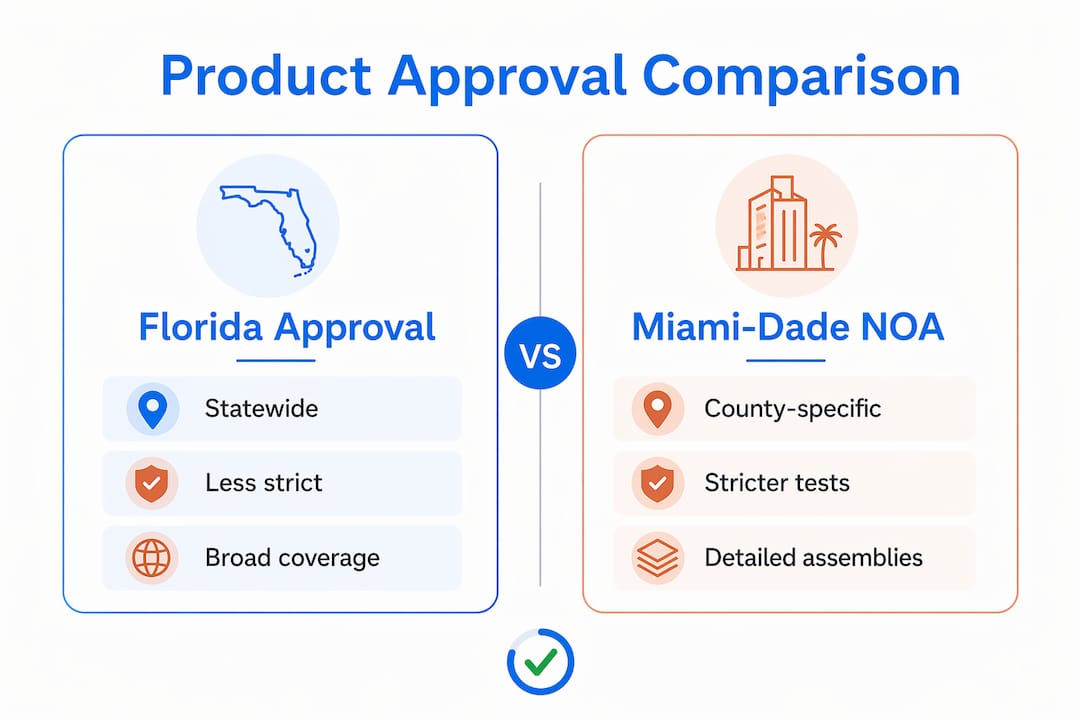
Miami-Dade County requires roofing materials to hold a Miami-Dade Notice of Acceptance (NOA) certification covering every component of the roofing assembly. The NOA is one of the strictest product approval standards in the United States, specifically designed for the HVHZ’s extreme wind speeds and wind-borne debris conditions. A product that passes Florida’s general statewide review may still fail Miami-Dade’s NOA testing. That gap matters enormously when you are filing a roofing permit application.
Florida Product Approval (FPA) is the statewide system administered through the Florida Building Commission. It covers a broad range of products and applies across all 67 Florida counties. The NOA, by contrast, is issued exclusively by Miami-Dade County’s product control division and applies stricter testing thresholds for wind uplift, impact resistance, and water infiltration. Think of FPA as the baseline and NOA as the county-specific upgrade required in the HVHZ.
The table below shows the key differences between the two systems.
| Feature | Florida Product Approval (FPA) | Miami-Dade NOA |
|---|---|---|
| Issuing authority | Florida Building Commission | Miami-Dade County Product Control |
| Geographic scope | All Florida counties | Miami-Dade HVHZ only |
| Testing rigor | Standard Florida Building Code | Stricter wind, impact, and water tests |
| Required in Miami-Dade? | No, unless NOA is unavailable | Yes, for all HVHZ roofing projects |
| Covers full assembly? | Varies by product | Yes, every component specified |
Pro Tip: Always confirm that the NOA number on your product documentation matches the specific product model and assembly method your contractor plans to install. A valid NOA for one shingle profile does not automatically cover a different profile from the same manufacturer.
Why does product approval documentation cause so many permit rejections?
Missing or expired NOA documents are among the most common causes of permit rejections in Miami-Dade. Plan reviewers check every roofing component against current certification records. If even one item is undocumented, the entire application stalls.
The Miami-Dade NOA covers the roofing material, underlayment, attachment method, fastener spacing, edge metal, and the full assembly. Substituting or omitting any single component without a current NOA is a frequent cause of permit failure. Many homeowners assume the surface shingle is the only product that needs certification. That assumption leads directly to rejection.
Common documentation problems that trigger plan review comments include:
- Expired NOA numbers. Certifications have expiration dates. An NOA that was valid when your contractor last used it may no longer be current.
- Mismatched product submissions. The product listed on the permit application must match exactly what is installed. A different color, thickness, or fastening pattern can void the approval.
- Incomplete assembly documentation. Submitting the shingle NOA without the underlayment or edge metal NOA leaves gaps that reviewers flag immediately.
- Using FPA where NOA is required. Substituting a general FPA product for a Miami-Dade NOA product in the HVHZ is a costly mistake that causes permit review failures.
- Missing installation specifications. Product approval certificates are legal documents specifying installation methods. Submitting the certificate number without the installation detail pages is not sufficient.
Pro Tip: Request the full NOA document from your contractor, not just the certificate number. The full document includes the approved installation method, which inspectors verify on-site.
Failed inspections caused by product documentation issues are not just a paperwork inconvenience. They require corrective action, which can mean tearing off installed materials and resubmitting with compliant products. That outcome costs far more than getting the documentation right before submission.
How does product approval affect your insurance and property value?
Verified wind-mitigation roofing products allow homeowners to claim insurance premium discounts through the Uniform Mitigation Verification Inspection Form. That form is completed by a licensed inspector who confirms that your roof meets specific construction standards. If your roofing products lack valid NOA certification or were installed without a permit, you cannot qualify for those discounts.
The financial stakes extend beyond insurance premiums. Unpermitted or non-approved roofing creates serious problems at the point of property sale. A title search or home inspection will surface unpermitted work. Buyers and their lenders treat unpermitted roofing as a liability. In Miami-Dade’s competitive real estate market, that liability translates directly into lower offers or failed closings.
Approved products also reduce the risk of insurance claim disputes after a storm. When a hurricane causes roof damage, your insurer will examine whether the roof was installed with certified materials and proper permits. A roof built with valid NOA products and a closed permit gives you a clean record. A roof without that documentation gives your insurer grounds to dispute the claim.
The benefits of proper product approval compliance include:
- Lower insurance premiums through the Uniform Mitigation Verification Inspection discount program
- Stronger claim outcomes after wind or storm damage events
- Higher resale value with a clean permit record and certified materials
- Legal protection against code enforcement actions on unpermitted work
What steps should you take to meet product approval requirements?
Getting your roofing permit application right the first time requires deliberate preparation. These steps apply whether you are a homeowner pulling an owner-builder permit or a small business owner managing a commercial roofing project.
-
Request NOA or FPA numbers for every component. Before your contractor orders materials, ask for the specific NOA or FPA number for the shingles, underlayment, fasteners, and edge metal. Homeowners should insist on seeing this documentation before approving any roofing contract.
-
Verify that each approval is current. Building inspectors require that product approvals be current at permit issuance time. Check the expiration date on every NOA document. An approval that expired six months ago will not satisfy a plan reviewer.
-
Build a schedule of approvals sheet. Professional permit reviewers prepare a detailed schedule of approvals listing all products with their unique product approval numbers. This sheet helps inspectors cross-reference installed products with approved documentation on-site. Create one for your project and include it in your permit package.
-
Confirm the full assembly is covered. Cross-check that every component in your roofing assembly has its own current NOA. Do not assume that one approval covers the entire system.
-
Do not rely on manufacturer warranties alone. Manufacturer warranties and generic impact labels are not a substitute for current, official FPA or NOA documentation. Miami-Dade inspectors require the official certification documents, not marketing materials.
-
Coordinate with your contractor on submission timing. Your contractor must submit complete, current product documentation during permit filing. Confirm this before the application goes in, not after a rejection notice arrives.
Pro Tip: Ask your contractor to provide a copy of the permit application package before submission. Review the product approval section yourself. You are the property owner, and a permit rejection affects your timeline and budget, not just your contractor’s.
Key Takeaways
Product approval documentation is the single most common reason roofing permits fail in Miami-Dade County, and verifying every assembly component before submission prevents the majority of rejections.
| Point | Details |
|---|---|
| NOA is stricter than FPA | Miami-Dade NOA requires more rigorous testing than general Florida Product Approval and is mandatory in the HVHZ. |
| Full assembly must be certified | Every component, including underlayment, fasteners, and edge metal, needs its own current NOA, not just the surface shingle. |
| Expired approvals cause rejections | Product approvals have expiration dates; inspectors require certifications to be current at permit issuance. |
| Insurance discounts depend on compliance | The Uniform Mitigation Verification Inspection discount requires verified, permitted, NOA-compliant roofing. |
| Schedule of approvals speeds inspections | A documented list of all product approval numbers helps inspectors verify compliance quickly on-site. |
Why most roofing permit problems are entirely preventable
After working through hundreds of Miami-Dade permit cases, the pattern is clear. The majority of roofing permit rejections trace back to one avoidable mistake: the homeowner or small business owner trusted their contractor to handle documentation without verifying it themselves.
Contractors know roofing. Not all of them know Miami-Dade’s product approval requirements at the level of detail that plan reviewers apply. Projects can stall for weeks when a contractor submits an FPA number where an NOA is required, or when the NOA on file has expired before the application date. These are not obscure technicalities. They are the standard checklist every Miami-Dade plan reviewer uses.
Another common mistake is treating product approval as a one-time box to check. Product approval certificates are legal documents specifying installation methods. If your contractor changes the fastener spacing or swaps the underlayment brand mid-project, the original NOA may no longer apply. That change needs to be documented and verified before the inspector arrives.
My honest advice: get the full NOA document for every component before your contractor orders a single square of material. Read the installation specifications. If something does not match what your contractor plans to do, ask the question before the permit is filed. A five-minute conversation at the start saves weeks of corrections at the end. For a deeper look at the Miami-Dade permit process, the documentation requirements are more manageable than they appear once you understand the structure.
How Miamipermitai helps you get roofing permits right the first time
Roofing permit applications in Miami-Dade fail most often because of product approval gaps that are entirely fixable before submission. Miamipermitai reviews your permit package against Miami-Dade’s actual requirements, flags missing or expired NOA documentation, and identifies assembly component mismatches before you submit to the county.
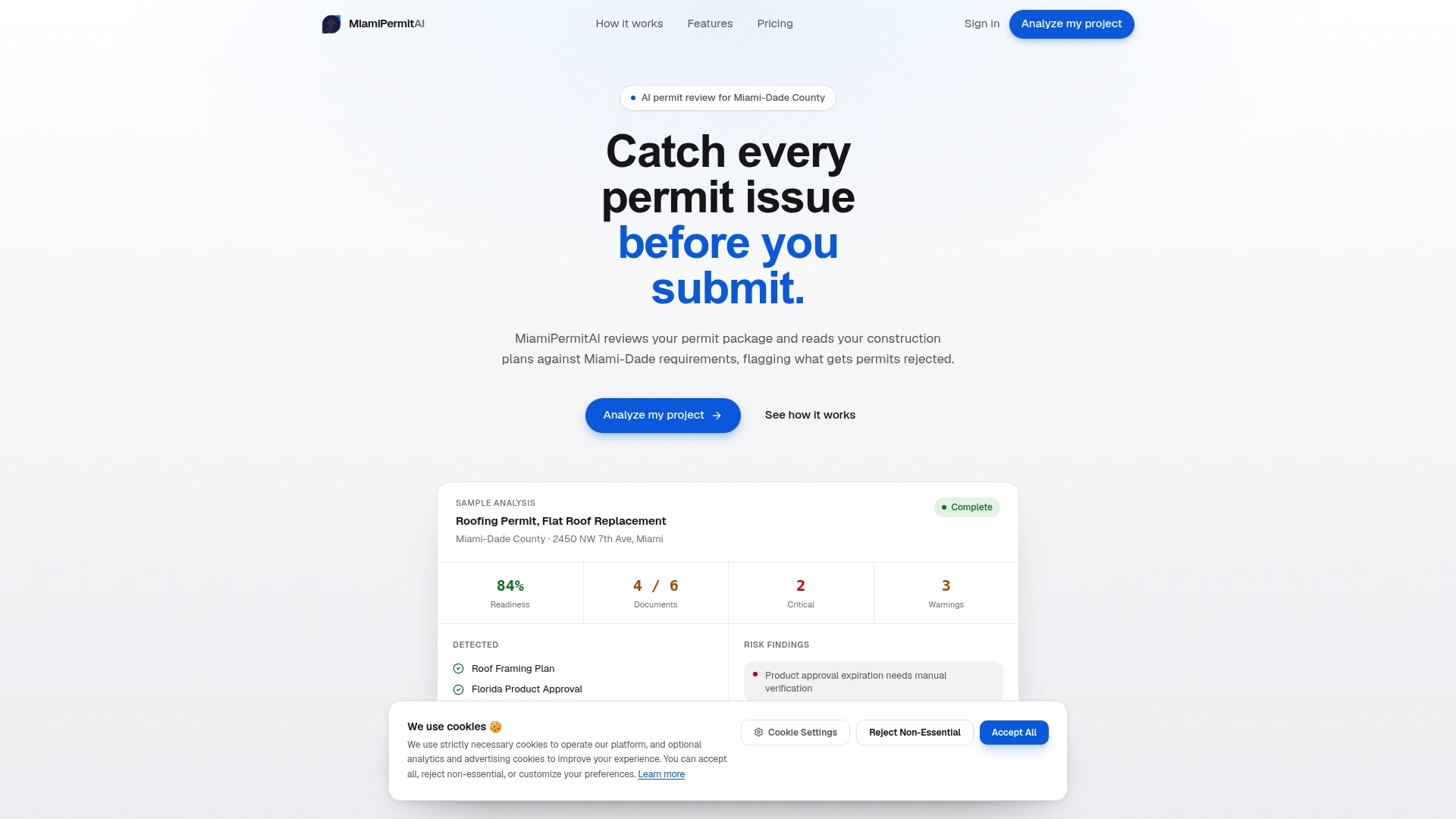
The platform checks your documents against Miami 21 zoning, FEMA flood zone data, and Florida DBPR contractor license records. You get a readiness score, a plain-language list of what to fix, and guidance on how to fix it. After you submit, Miamipermitai tracks your permit status using public Miami-Dade records and sends you email updates. Check your permit package before it goes in and avoid the rejection cycle that costs Miami-Dade homeowners weeks of delays every year.
FAQ
What is a Miami-Dade NOA and why is it required?
A Miami-Dade Notice of Acceptance (NOA) is a product certification issued by Miami-Dade County confirming that a roofing product meets the HVHZ’s strict wind and impact resistance standards. It is required for all roofing permits in Miami-Dade because the county’s High Velocity Hurricane Zone designation demands higher performance than the general Florida Building Code.
Can I use a Florida Product Approval instead of an NOA in Miami-Dade?
No. Substituting a general Florida Product Approval for a Miami-Dade NOA in the HVHZ is a common mistake that causes permit review failures. Miami-Dade NOA testing is more rigorous, and plan reviewers will reject applications that substitute FPA documentation where an NOA is required.
What roofing components need their own product approval?
Every component of the roofing assembly requires its own current NOA, including the surface material, underlayment, fasteners, attachment method, and edge metal. Submitting only the shingle NOA and omitting the underlayment or fastener documentation is a frequent cause of incomplete permit applications.
How do I check if a product approval is still valid?
Check the expiration date printed on the NOA document itself. You can also verify current NOA status through Miami-Dade County’s online product control database. Building inspectors require approvals to be current at the time of permit issuance, not just at the time of installation.
Does unpermitted roofing affect my homeowner’s insurance?
Yes. Unpermitted roofing without verified NOA-compliant products can disqualify you from insurance premium discounts available through the Uniform Mitigation Verification Inspection Form and may give your insurer grounds to dispute storm damage claims. A closed permit with certified materials protects both your coverage and your property’s resale value.
Recommended
Is your permit package ready?
Run an AI readiness check against Miami-Dade requirements before you submit.
Start your first projectThis article is general guidance and not legal, engineering, or official county advice. Always verify requirements with Miami-Dade County before submitting a permit.