By the MiamiPermitAI team · July 18, 2026 · Updated September 30, 2026
Why Permit Drawings Need an Engineer Stamp

An engineer stamp on permit drawings is the formal certification of a licensed Professional Engineer (PE) confirming that the structural design meets all applicable safety codes required for permit approval. In Miami-Dade, this stamp is not optional for most construction projects. Understanding why permit drawings need an engineer stamp protects you from costly rejections, multi-week delays, and legal exposure. The stamp transfers professional liability from the building department to the licensed engineer, which is exactly why Miami-Dade building officials treat it as a hard requirement, not a formality.
Why permit drawings need an engineer stamp: the legal and technical meaning
An engineer stamp, formally called a PE seal, is more than a signature. The seal certifies that the engineer has directly supervised the work and assumes legal accountability for the structural design’s adequacy. That accountability is what building departments are actually checking when they review your permit package.
A valid PE seal must display the engineer’s license number, their engineering discipline (structural, civil, mechanical), and the jurisdiction where they are licensed. Florida has specific formatting requirements for this seal. Any deviation, such as a missing license number or the wrong discipline listed, gives the building department grounds to reject the submission outright.
The stamp also carries real legal weight. Engineering verification transfers liability for structural safety from building officials to the licensed engineer. If a structure fails and the drawings were stamped, the engineer bears professional and legal responsibility. That accountability chain is the entire point of the requirement.

A common misconception is that the stamp is just a rubber formality. It is not. The PE who stamps drawings must have personally prepared or directly supervised every aspect of the design. Stamping work you did not oversee is illegal in Florida and in every other U.S. state.
Pro Tip: Always verify that the engineer’s license number on the stamp matches an active Florida license. You can confirm this through the Florida Department of Business and Professional Regulation (DBPR) license lookup tool at no cost.
Key elements a valid PE seal must include:
- Full name of the licensed engineer
- Florida PE license number
- Engineering discipline (e.g., structural, civil)
- State of licensure (Florida)
- Original wet or digital signature
- Date the drawings were sealed
Why Miami-Dade building departments require engineer stamps
Miami-Dade building officials require engineer-stamped plans because architectural drawings alone cannot verify structural integrity. An architect can show what a building looks like and how spaces are arranged. Only a structural engineer can confirm that the beams are sized correctly, the connections are adequate, and the load paths work under real-world conditions.
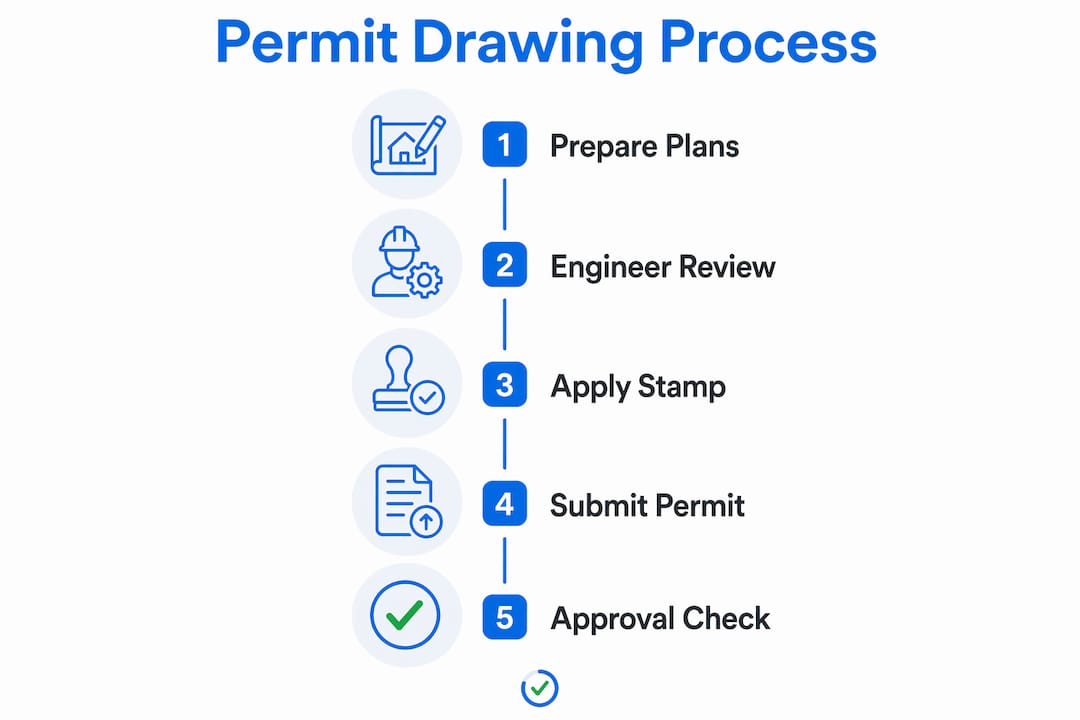
Miami-Dade sits in one of the most demanding building environments in the country. The county enforces the Florida Building Code, which incorporates requirements from the International Building Code (IBC) and the International Residential Code (IRC). Projects must also account for high-wind loads, hurricane-force conditions, and FEMA flood zone requirements. Structural calculations stamped by a PE demonstrate compliance with all of these conditions simultaneously.
The consequences of submitting without a required stamp are immediate and expensive. Missing required stamps forces weeks-long correction cycles and multiple rounds of communication with the building department. Every week a permit sits in correction status costs a contractor holding fees, delayed project starts, and lost revenue. For homeowners, it means living with an incomplete project longer than planned.
Here is the sequence of what happens when a permit package arrives without a required engineer stamp:
- The building department flags the submission as incomplete during the initial intake review.
- The applicant receives a correction notice listing the missing documentation.
- The applicant must hire a PE, have the drawings reviewed and stamped, and resubmit.
- The permit clock restarts from the resubmission date.
- Additional review fees may apply depending on the scope of corrections.
That five-step detour is entirely avoidable. Consulting local building plan checklists before you start drawing up plans tells you exactly which projects require a PE stamp in Miami-Dade.
Which Miami-Dade projects require engineer-stamped drawings?
Most states require a licensed engineer to seal plans for new homes above a certain size, structural modifications, or commercial projects. Miami-Dade follows this pattern and adds its own local requirements on top of state minimums.
| Project type | Engineer stamp required? |
|---|---|
| New commercial construction | Yes, always |
| Commercial tenant improvements | Yes, for structural work |
| Residential addition over 1,000 sq ft | Yes, typically required |
| Load-bearing wall removal | Yes |
| Foundation work | Yes |
| Standard residential re-roof | Generally no |
| Non-structural interior remodel | Generally no |
| Accessory structures (sheds, fences) | Depends on size and wind exposure |
The prescriptive path exemption is the most misunderstood concept in this area. Florida’s building code allows some small residential projects to follow a prescriptive path, meaning they use pre-approved standard details instead of custom engineering calculations. The exemption is narrow. It applies to simple, low-risk work that fits exactly within the code’s defined parameters. The moment a project deviates from those parameters, even slightly, a PE stamp becomes mandatory.
Load-bearing changes are the most common trap. A homeowner removes what they believe is a non-structural wall, only to discover during inspection that it carried roof loads. At that point, the project needs retroactive structural engineering, a stamped drawing, and a permit amendment. The cost and delay are far greater than getting the engineering done upfront.
Pro Tip: For any project involving structural modifications in Miami-Dade, review the structural permit package requirements before hiring your contractor. Knowing what the building department expects saves you from surprises at submission.
Common mistakes that get permit drawings rejected
The most frequent stamp-related rejection reason is simply not including a stamp when one is required. Building officials treat the absence of a PE stamp as a primary cause for permit rejection, which triggers multi-week delays and holding costs. Applicants often assume their project qualifies for an exemption when it does not.
Beyond missing stamps entirely, these errors also cause rejections:
- Incorrect stamp information. A license number that does not match DBPR records, a wrong discipline, or an expired license all void the seal.
- Missing signature or date. Improper application of the seal, including misplaced signatures and missing dates, can void permits. Florida rules require an original signature alongside the seal.
- Rubber stamp used in place of a signature. A pre-printed signature is not a valid substitute for the engineer’s original wet or digital signature.
- Stamp from the wrong discipline. A civil engineer cannot stamp structural drawings. The discipline on the seal must match the type of work being certified.
- Illegal plan stamping. Engineers who stamp work they did not prepare or supervise expose themselves to license revocation and criminal penalties. Contractors who knowingly submit such drawings share in that legal risk.
The illegal plan stamping issue deserves extra attention. Some applicants, under time pressure, ask an engineer to stamp drawings they had no involvement in creating. This practice is called “plan stamping” and it is a serious violation. The engineer loses their license. The permit, if approved, can be revoked. Any construction built under that permit may need to be torn down or re-engineered at the owner’s expense.
How to get a valid engineer stamp on your permit drawings
Getting a valid PE stamp starts with hiring the right engineer. The engineer must hold an active Florida PE license, and their discipline must match your project type. A structural engineer handles load-bearing work, foundations, and framing. A civil engineer handles site work, drainage, and utilities. Using the wrong discipline is a rejection waiting to happen.
Follow these steps to move from drawings to a valid stamped set:
- Hire a licensed Florida PE with the correct discipline for your project scope. Verify their license status through the Florida DBPR before signing any contract.
- Share complete project information. The engineer needs architectural drawings, site plans, soil reports if applicable, and any existing structural documentation for the building.
- Allow time for engineering review. The PE must personally review and, in many cases, revise the drawings before stamping. Rushing this step creates errors.
- Confirm the stamp meets Miami-Dade requirements. The sealed plans requirements for Miami-Dade include specific formatting rules for digital and wet seals.
- Keep a complete record. Maintain copies of all stamped drawings, the engineer’s license documentation, and any correspondence. Building officials may request these during inspections.
Pro Tip: Ask your PE to provide a stamped copy of their structural calculations alongside the drawings. Miami-Dade building reviewers often request these calculations separately, and having them ready prevents another round of corrections.
Key Takeaways
Engineer stamps on permit drawings are legally required certifications that verify structural safety, assign professional liability to a licensed PE, and are the most common missing element in rejected Miami-Dade permit submissions.
| Point | Details |
|---|---|
| Stamps carry legal liability | The PE assumes full responsibility for structural adequacy when they seal drawings. |
| Architectural drawings are not enough | Only a stamped structural drawing confirms beam sizing, load paths, and code compliance. |
| Missing stamps cause multi-week delays | Permit corrections from absent stamps restart the review clock and add holding costs. |
| Prescriptive exemptions are narrow | Most structural modifications in Miami-Dade require a PE stamp regardless of project size. |
| Illegal stamping has serious consequences | Engineers who stamp work they did not supervise risk license revocation and criminal charges. |
Why Miami-Dade permits stall over stamps
The engineer stamp issue is a major source of avoidable pain in the Miami-Dade permit process. Contractors who have been building for decades sometimes assume they know which projects need a stamp and which ones do not. That assumption is expensive when it is wrong.
A common pattern: a contractor submits a permit for what looks like a straightforward addition. The building department kicks it back because the structural drawings are not stamped. The contractor then scrambles to find a PE willing to stamp drawings they did not create. No reputable engineer will do that. So the drawings have to be redone, the PE has to start from scratch, and the project sits idle for weeks.
The harder truth is that the stamp requirement is not bureaucratic friction. It exists because Miami-Dade’s wind and flood exposure genuinely demands engineering-level verification. A beam that works fine in Atlanta may be undersized for the High-Velocity Hurricane Zone design wind loads required in Homestead. The PE stamp is the mechanism that catches those gaps before concrete gets poured.
The practical takeaway: treat the engineering review as part of the design phase, not a box to check at the end. Bring a structural engineer into the project early. The cost of their involvement upfront is a fraction of the cost of a rejected permit, a redesign, and a delayed project start.
Check your permit package before it hits the building department
Stamp-related rejections are one of the most common reasons Miami-Dade permit applications come back with corrections. Miamipermitai reviews your full permit package against Miami-Dade requirements before you submit, flagging missing engineer stamps, incomplete structural documentation, and other issues that trigger rejection.

The platform checks your drawings against Miami 21 zoning, FEMA flood zone requirements, and Florida DBPR contractor license records. You get a clear readiness score and a plain-language list of what to fix. After you submit to the county, Miamipermitai tracks your permit status and sends you updates by email. Check your permit package before it costs you weeks of corrections.
FAQ
What is an engineer stamp on permit drawings?
An engineer stamp, or PE seal, is a licensed Professional Engineer’s formal certification that the structural design on permit drawings meets applicable safety codes. It includes the engineer’s name, license number, discipline, and signature.
Do all Miami-Dade permit drawings need an engineer stamp?
Not all drawings require a stamp, but most structural work does. New commercial construction, load-bearing modifications, foundations, and large residential additions all require a PE stamp in Miami-Dade.
What happens if you submit permit drawings without a required stamp?
The building department rejects the submission and issues a correction notice. The applicant must obtain a stamped set and resubmit, restarting the review clock and potentially incurring additional fees.
Can any engineer stamp my permit drawings?
No. The engineer must hold an active Florida PE license, and their discipline must match the type of work. A civil engineer cannot stamp structural drawings, and an out-of-state license is not valid for Florida permits.
Is it legal to have an engineer stamp drawings they did not create?
No. Florida law requires engineers to stamp only work they personally prepared or directly supervised. Stamping drawings without that involvement is illegal and can result in license revocation and criminal penalties.
Recommended
Is your permit package ready?
Run an AI readiness check against Miami-Dade requirements before you submit.
Start your first projectThis article is general guidance and not legal, engineering, or official county advice. Always verify requirements with Miami-Dade County before submitting a permit.