
July 22, 2026
The Best CodeComply.AI Alternatives for US Professionals

The Best CodeComply.AI Alternatives for US Professionals
What are the top CodeComply.AI alternatives available in the US?
Six platforms stand out as the leading CodeComply.AI alternatives for US building code compliance and plan review: mbue, CivCheck, OpenCounter, Code Unlimited, Bluerithm, and uDrew. Each takes a different angle on AI-driven compliance, from automated architectural quality control to municipal permitting workflows and field inspection tools.
- mbue: AI-based quality control for architecture, engineering, and construction plan review
- CivCheck: Guided AI plan review integrated with municipal permitting services
- OpenCounter: Permit application and licensing automation for government technology workflows
- Code Unlimited: Consulting and compliance across accessibility, fire protection, and hazardous materials
- Bluerithm: Cloud-based commissioning, BIM workflow, and QA/QC project management
- uDrew: AI-driven site inspection, planning, and field compliance for construction and real estate
Professionals choosing among these tools should know that selecting the right platform depends heavily on user role, jurisdiction, and workflow needs rather than any single feature.
How do these CodeComply.AI competitors compare on features and fit?
Each platform targets a distinct segment of the compliance workflow, so the right pick depends on where your bottleneck actually lives.
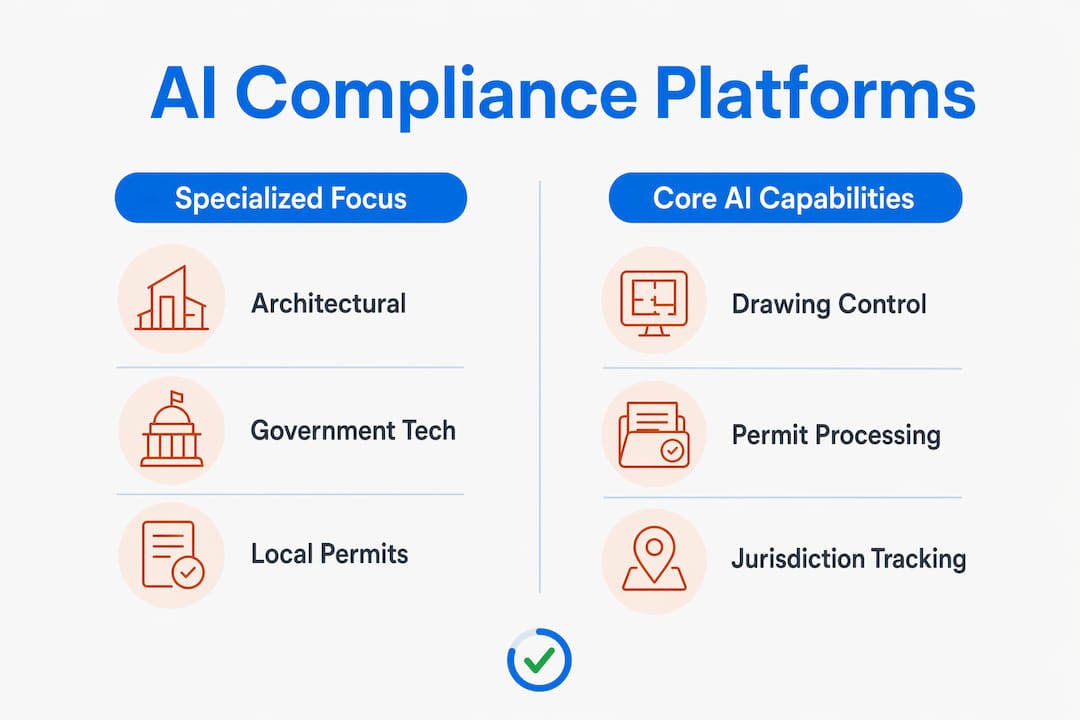
| Platform | Primary Focus | Core AI Capabilities | Best For |
|---|---|---|---|
| mbue | Architectural quality control | Automated plan review, AI compliance checking | AECO firms automating drawing review |
| CivCheck | Municipal plan review | Guided AI plan review, permitting integration | Municipalities and design firms |
| OpenCounter | Permitting and licensing software | Workflow automation, permit application processing | Government tech and permit applicants |
| Code Unlimited | Multi-domain compliance consulting | AI-supported accessibility, fire, hazmat compliance | Facility owners and design teams |
| Bluerithm | Technical project management | BIM workflow, QA/QC, commissioning tracking | Construction commissioning teams |
| uDrew | Site inspection and planning | AI-driven field data and compliance insights | Construction and real estate professionals |

mbue focuses squarely on the AECO sector, automating the kind of drawing-level quality control that traditionally eats hours of an architect’s time. CivCheck is the strongest option when the goal is connecting plan review directly to a municipal permitting pipeline. Its guided AI review platform is built around the back-and-forth between applicants and city staff, which makes it especially useful for design firms that submit frequently to the same jurisdictions.
OpenCounter sits on the government technology side, reducing friction in the permit application process itself rather than checking drawing compliance. Code Unlimited is different from the rest: it leads with consulting expertise across accessibility, fire protection, and hazardous materials, then layers in AI support. That mix suits facility owners managing complex, multi-code projects. Bluerithm combines commissioning management with BIM workflows and QA/QC tracking, making it the natural fit for construction teams that need compliance documentation woven into project management. uDrew focuses on the field, using AI to connect site inspection data with planning and compliance requirements.
All six platforms offer demos, and most can provide customer references on request. Pricing is not publicly listed for most of these tools; direct contact with each vendor is the standard path to a quote.
How to choose the right AI building code compliance software
The decision comes down to five practical factors.
- Jurisdiction coverage: Does the tool track state and local code amendments, not just the base IBC or IFC? This is the single most common gap in AI compliance tools.
- AI precision and scope: Some platforms check drawings against code; others automate permit workflows. Know which problem you are actually solving.
- Integration: Will it connect with your existing tools, whether that is Revit, Procore, Bluebeam Revu, or a municipal permitting portal?
- Support and training: Look for onboarding resources, live support, and documentation that matches your team’s technical level.
- Security and data privacy: Confirm the platform’s data handling practices, especially if you are uploading sealed construction documents.
On pricing, most of these platforms use custom or enterprise pricing models. Request a demo before committing, and ask specifically about total cost of ownership including setup, training, and any per-project fees.
Pro Tip: Ask each vendor whether their tool tracks local code amendments and jurisdiction-specific bulletins, not just the base model code. A tool that only checks against the IBC without accounting for Florida’s amendments or a city’s local ordinances will miss the issues that actually cause permit rejections.

Why local code expertise determines AI compliance accuracy
AI-generated compliance reports function as preliminary summaries, not final determinations. NCARB is direct on this point: AI outputs identify potential issues but do not replace professional code interpretation. Licensed architects remain responsible for every compliance determination that goes on a set of drawings.
The deeper problem is jurisdictional specificity. Building codes vary by state and municipality because local amendments layer on top of national base codes like the IBC. A tool that checks only against the base code will miss what New York, California, or Florida actually require. Tools that track local amendments and bulletins give teams a much more accurate picture of what a specific jurisdiction will flag at permit review.
Key insight: AI compliance tools provide valuable initial code review, but they must be paired with expert human judgment and local knowledge for final approvals.
Pro Tip: When evaluating any AI compliance platform, ask for a live demo using a real project from your primary jurisdiction. Generic demos often use simplified examples that don’t reflect local amendment complexity. A demo on your actual code environment reveals gaps that a sales presentation won’t.
For teams working across local code amendments and jurisdiction-specific requirements, this distinction between base-code checking and true local compliance is where most AI tools either earn their cost or fall short. Also worth noting: AI tools for project planning are increasingly capable, but the licensed professional review step remains non-negotiable in every US jurisdiction.
What do real users say about these platforms?
Customer references and case study availability vary across these six platforms. mbue and CivCheck both position themselves toward enterprise and municipal clients, where formal case studies and reference calls are standard parts of the sales process. OpenCounter has documented deployments with municipal governments, where the measurable outcome is reduced counter time and faster permit issuance. Bluerithm’s user base in commissioning and construction management tends to generate project-specific documentation rather than public case studies, but the platform’s focus on QA/QC creates an audit trail that teams can reference internally. Code Unlimited’s consulting model means client outcomes are often confidential, though the firm can typically arrange references for prospective clients. uDrew is newer to the market and has less publicly available case study material. For any of these tools, requesting a reference from a client in your specific jurisdiction and project type is worth the extra step in the evaluation process.
Miamipermitai offers a different route for Miami-Dade permit readiness
If you’re working in Miami-Dade County specifically, the platforms above are built for broad US markets. Miamipermitai takes a narrower, deeper approach: it reviews your permit package against Miami-Dade’s actual requirements before you submit, flagging missing documents, plan inconsistencies, and the specific issues that cause rejections at the county level.
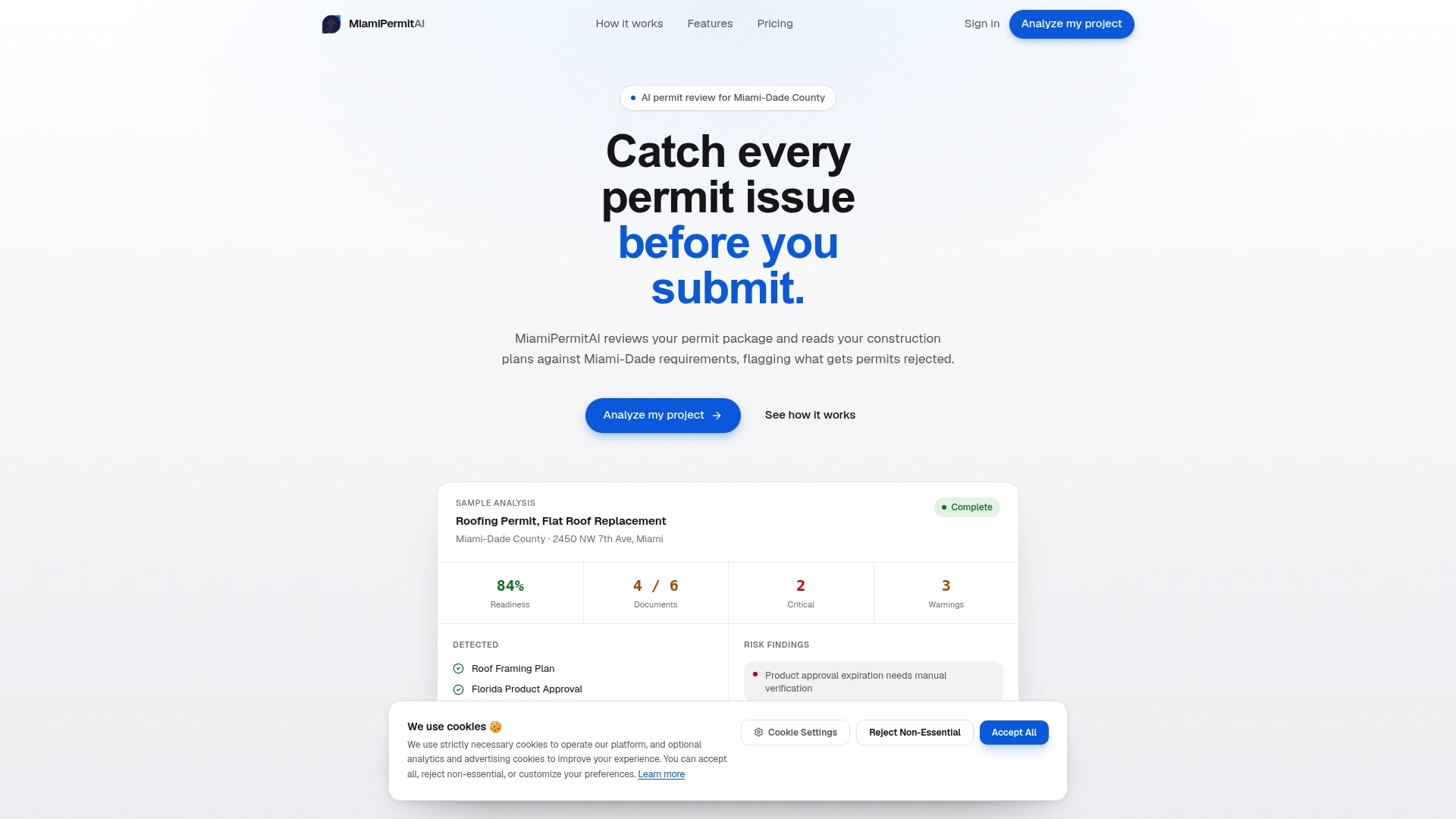
The platform pulls from Miami 21 zoning, FEMA flood zones, folio property records, and Florida DBPR contractor license verification. You get a readiness score, a plain-language fix list, and post-submission permit tracking via public Miami-Dade records. For contractors, architects, and homeowners navigating Miami-Dade permit submissions, that local depth is something a general-purpose compliance tool won’t replicate.
Key Takeaways
The strongest AI compliance tool for your practice is the one that covers your actual jurisdiction’s amendments, not just the base model code.
| Point | Details |
|---|---|
| Six leading alternatives | mbue, CivCheck, OpenCounter, Code Unlimited, Bluerithm, and uDrew each target a distinct compliance workflow. |
| Local amendments matter most | Tools must track state and municipal code changes beyond the IBC to reflect real permit requirements. |
| AI is a first-pass tool | Licensed professionals must verify all AI-generated compliance outputs before submission. |
| Demos reveal real gaps | Testing a platform against your actual jurisdiction exposes limitations that generic demos hide. |
| Miamipermitai for Miami-Dade | Miamipermitai provides jurisdiction-specific permit readiness review grounded in Miami-Dade and Florida data. |
Recommended
Is your permit package ready?
Run an AI readiness check against Miami-Dade requirements before you submit.
Try your first analysis freeThis article is general guidance and not legal, engineering, or official county advice. Always verify requirements with Miami-Dade County before submitting a permit.