
August 8, 2026
Miami-Dade NOA Product Approval Requirements Checklist
Miami-Dade NOA Product Approval Requirements Checklist
To prove a product holds a valid Miami-Dade Notice of Acceptance when filing a permit, attach the following to your submittal: the NOA number and approval document with expiration date, manufacturer-approved drawings and labeling, TAS 301 lab reports where required, a signed and sealed engineer or architect statement, and (for roofing permits) the Affidavit and Verification Form signed by the registered professional of record.
Before you attach anything, confirm the NOA number in the Miami-Dade Product Control Search. That database shows the manufacturer, product description, design pressure ratings, and expiration date. NOAs typically run for a multiple-year period; a permit will not be issued against an expired one.
| Item | Detail |
|---|---|
| NOA validity | Verified in Product Control Search |
| Required lab standard | TAS 301 certified labs only |
| New NOA processing time | Typically several months for new, shorter for revision or renewal |
| Test age limit | No older than 2 years for new approvals |
Your permit documents checklist should include: scanned NOA pages, manufacturer installation instructions referenced in the NOA, shop drawings marked to match the NOA configuration, engineer-sealed calculations, and any private-labeler or distributor agreements when the applicant is not the manufacturer.
Table of Contents
- Five pre-submit actions that prevent Miami-Dade NOA product approval rejections
- Why precise NOA documentation keeps your permit moving
- Miamipermitai flags NOA issues before they reach the county
- Official Miami-Dade sources to verify NOAs and prepare your submittal
- Key Takeaways
- The part of NOA compliance most contractors underestimate
Five pre-submit actions that prevent Miami-Dade NOA product approval rejections
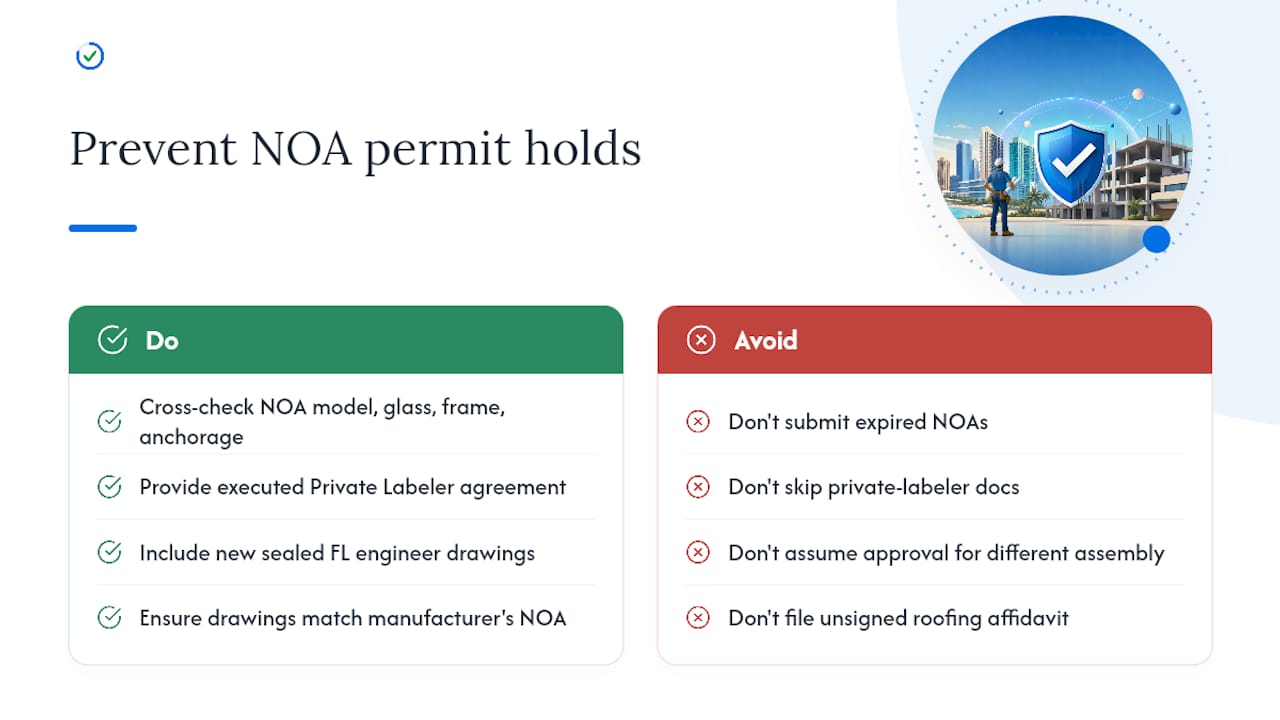
- Verify the NOA is active. Pull the NOA number in the Miami-Dade Product Control Search and confirm the expiration date has not passed.
- Include NOA pages plus installation instructions. The NOA general submittal guide requires both; missing either is an automatic hold.
- Submit the Affidavit for roofing permits. The Affidavit and Verification Form must be signed by the registered professional of record at time of application, not after.
Hard stops reviewers flag most often: expired NOA, manufacturer name on the application that does not match the NOA exactly, double-sided printed documents, and unsigned affidavits.
Why precise NOA documentation keeps your permit moving
Expired window NOAs are the single most common hold on envelope permits. A contractor submits impact windows with an NOA that lapsed three months prior, and the permit stops cold until a valid NOA is sourced or a one-time approval is filed with sealed engineering, a letter of purpose, and fee payment.
The private-labeler edge case catches people off guard. When the applicant is a distributor rather than the manufacturer, Miami-Dade requires an executed Private Labeler or Distributor agreement plus a new drawing set signed and sealed by a Florida-licensed engineer, with the distributor’s name on the title block. The engineering must be identical to the manufacturer’s NOA drawings. Skipping this produces an immediate rejection.
Pro Tip: Before submitting, cross-check the NOA model number, glass type, frame configuration, and anchorage spacing against the approved drawings. Approval for a similar product does not carry over to a different assembly.
For roofing, plan reviewers treat the Affidavit as a legal attestation. Signed by the wrong person or left unsigned, it triggers an administrative hold regardless of how clean the rest of the package is. See the full roofing product approval guide for the complete roofing-specific checklist.
Miamipermitai flags NOA issues before they reach the county
Catching a mismatched manufacturer name or an expired NOA after submission costs you days or weeks in the review queue. Miamipermitai runs your permit package against Miami-Dade Product Control data before you upload anything to the county portal, flagging expired NOAs, configuration mismatches, missing seals, and absent affidavits in a single preflight report.
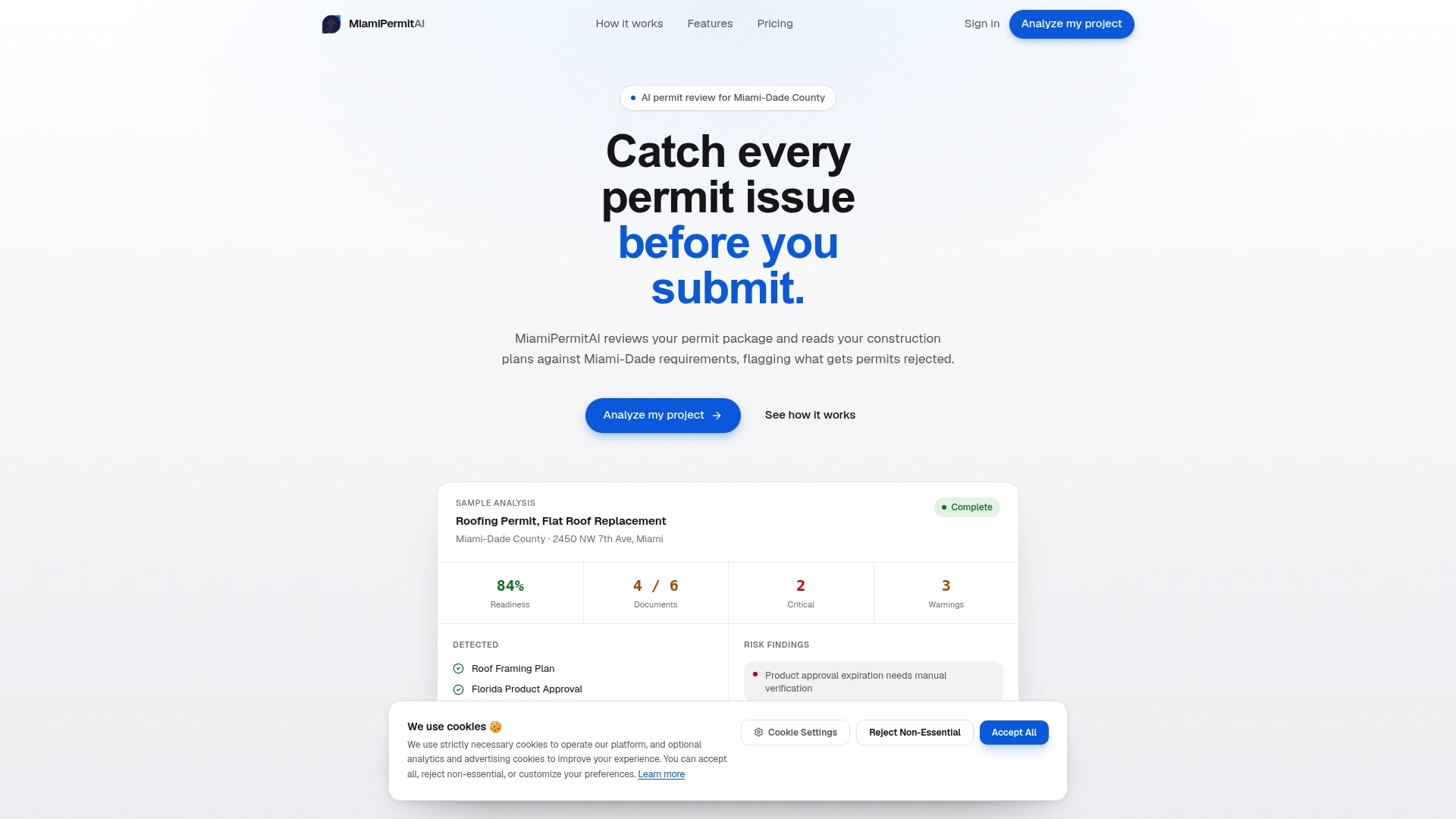
Contractors who submit frequently can use a monthly subscription for unlimited analyses. One-time users get a full readiness report for a single permit. Either way, you receive a downloadable fix list with plain-language guidance tied to the exact Miami-Dade requirement you need to satisfy. Check your permit package now before the county tells you what is missing.
Official Miami-Dade sources to verify NOAs and prepare your submittal
Bookmark these before you build your permit package:
- Miami‑Dade Product Control Search
- Affidavit and Verification Form (roofing/private provider)
- NOA general submittal information (Miami‑Dade Product Control)
- One‑time approval checklist (Miami‑Dade)
- NOA basic requirements checklist (Miami‑Dade Product Control)
- Miami‑Dade County Product Approval (Product Control Section)
- Product control NOA application and instructions (Miami‑Dade)
Key Takeaways
A valid, unexpired NOA matched exactly to the installed product’s model, configuration, and manufacturer name is the single document that determines whether a Miami-Dade permit moves forward or stops at first review.
| Point | Details |
|---|---|
| NOA must be active at submittal | Permits will not be issued against an expired NOA; verify in Product Control Search before filing. |
| Exact assembly match required | Frame, glass, and anchorage must match the NOA configuration, not just the product family. |
| Roofing needs the Affidavit | The signed Affidavit and Verification Form by the registered professional is required at time of roofing permit application. |
| Test age limits apply | Lab reports for new approvals must be no older than 2 years; TAS 301 certified labs only. |
| Miamipermitai pre-checks your package | The platform flags expired NOAs, missing seals, and configuration mismatches before you submit to the county. |
The part of NOA compliance most contractors underestimate
Most permit rejections tied to product approvals are not about wrong products. They are about right products with sloppy paperwork. An impact window with a perfectly valid NOA still fails review if the manufacturer name on the application is abbreviated differently from the NOA, or if the installer submits the product family brochure instead of the actual NOA pages.
The county processes roughly 1,250 product approval applications annually. That volume means reviewers apply formatting and documentation rules without discretion. A drawing printed double-sided gets discarded, full stop. No phone call, no warning.
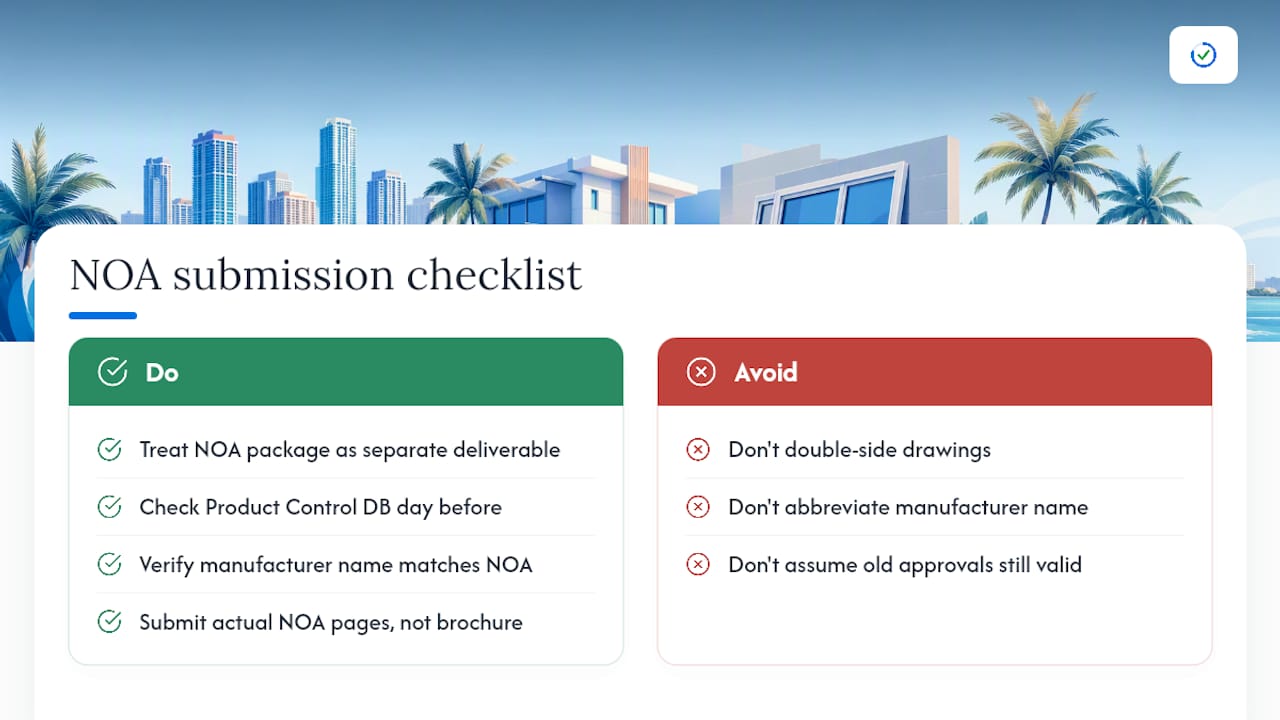
The contractors who move fastest through Miami-Dade review are not the ones with the most experience. They are the ones who treat the NOA package as a separate deliverable from the construction drawings, check it against the Product Control database the day before submission, and never assume that a product approved last year is still approved today.
Recommended
Is your permit package ready?
Run an AI readiness check against Miami-Dade requirements before you submit.
Try your first analysis freeThis article is general guidance and not legal, engineering, or official county advice. Always verify requirements with Miami-Dade County before submitting a permit.