
August 9, 2026
Best PermitRockstar.com Alternatives for Miami-Dade
Best PermitRockstar.com Alternatives for Miami-Dade
For Miami-Dade permit work, Miamipermitai is a strong local alternative to PermitRockstar. It checks Miami 21 zoning, FEMA flood zones, DBPR contractor license status, and folio property records before you submit, then tracks your permit through the county using public records and sends status updates by email.
Here are the three types of alternatives you will encounter in this comparison:
- AI permit-readiness platforms (Miamipermitai, PermitRockstar): pre-submission checks, readiness scores, and fix lists before you file with the county
- Licensed local expeditors and human permit agents: file directly with Miami-Dade on your behalf, leverage county relationships, and manage resubmittals
- National filing or data services and DIY county submission: volume-oriented APIs, document generation tools, or self-service submission through the county portal
Key Takeaways
Miami-Dade permit rejections most often trace back to Miami 21 zoning gaps, missing flood zone documentation, and unverified contractor licenses — all of which a local readiness check catches before submission.
| Point | Details |
|---|---|
| Top pick for Miami-Dade | Miamipermitai checks Miami 21 zoning, FEMA flood zones, DBPR licenses, and tracks post-submission status. |
| Best for local filing | A licensed human expeditor files directly with Miami-Dade and manages resubmittals on complex or contested permits. |
| Best for low-cost data access | PermitStack offers a free tier (100 requests/day) and a $49/month developer plan with daily-refresh data and webhooks for teams needing permit data via API. |
| Three quick decision checks | Confirm local Miami-Dade zoning compliance. coverage, DBPR contractor verification, and post-submission tracking before choosing any service. |
| Miamipermitai’s role | Free preview plus paid one-time or subscription reports; catches the local compliance gaps that cause county corrections. |
Table of Contents
- What are the real differences between PermitRockstar.com alternatives?
- How to choose the right alternative for your Miami-Dade project
- How does Miamipermitai compare to other PermitRockstar alternatives?
- What do users say about top PermitRockstar.com alternatives?
- How do these alternatives compare on customer support?
- Which alternatives integrate with construction and project management software?
- Is there a mobile app for managing permits on the go?
- How do these services handle data security and privacy?
- Why Miami-specific readiness checks matter more than most people realize
- Get a Miami-specific permit readiness check before you submit
- Sources
What are the real differences between PermitRockstar.com alternatives?
The category splits into four service models, and the gap between them matters more in Miami-Dade than almost anywhere else in Florida. Miami 21 zoning is one of the most complex form-based codes in the country, FEMA flood zone requirements add elevation certificate obligations, and the county’s rejection rate for incomplete packages is high enough that pre-submission preparation is not optional.
| Service type | Miami-Dade features (Miami 21, flood/elevation) | Filing capability | Post-submission tracking | Pricing model | Typical turnaround | Contractor verification | Best use case |
|---|---|---|---|---|---|---|---|
| AI readiness platform | Miami 21 zoning, FEMA flood zones, folio records, DBPR checks | Prepares documents; applicant files with county | Yes, via public records + email updates | One-time review or subscription | Hours to 1 business day | Yes (DBPR license check) | Contractors, homeowners, investors needing pre-submission confidence |
| Human expeditor | Varies by firm; strong local knowledge | Files directly with Miami-Dade | Varies by firm | Hourly or per-permit | Days to weeks | Informal (relationship-based) | Complex projects, resubmittals, contested permits |
| National filing/data service | Limited or none for Miami 21 specifics | Varies; some file, some generate only | Limited | Subscription or per-permit | Hours to days | Rarely | High-volume developers, lead generation, API consumers |
| DIY county portal | None; applicant must know the rules | Applicant files directly | Via county portal only | Free (county fees apply) | Weeks | None | Experienced contractors with local code knowledge |
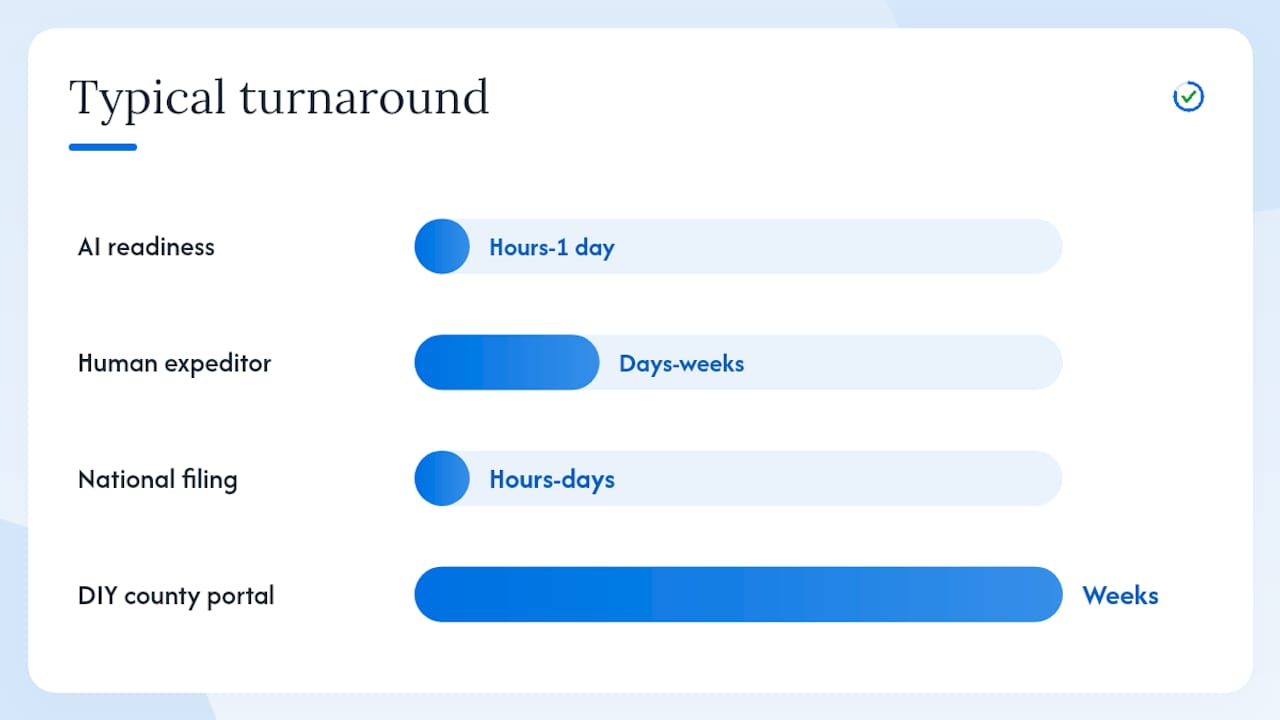
AI readiness platforms catch missing sealed sheets, wrong setback dimensions, and flood elevation gaps before the county sees your package. The tradeoff: you still file yourself.
Human expeditors are the right call when a project is contested, involves variances, or has already been rejected. Their county relationships matter. The cost is higher and the timeline depends on their workload.
National filing or data services like PermitStack (free tier, $49/month developer plan with daily refreshes and webhooks) serve developers who need programmatic permit data or volume document generation, not Miami-specific compliance checks. PermitPortal takes a higher-touch AI analyst approach, delivering 48-hour site risk briefs and ongoing jurisdiction monitoring for large development teams. Neither is built around Miami 21 or DBPR verification.
DIY submission through the county portal works if you already know Miami 21 setbacks, flood zone requirements, and what sealed plans your project type demands. Most homeowners and first-time investors do not.
Pro Tip: Before hiring any expeditor or running a readiness check, pull your folio number from the Miami-Dade Property Appraiser site and confirm your FEMA flood zone designation at the FEMA Flood Map Service Center. Both take under five minutes and will immediately tell you whether elevation certificates are in play, which changes your document list before you spend a dollar on any service.
How to choose the right alternative for your Miami-Dade project
The right choice depends on three things: what your project needs, what the provider actually covers, and what you are willing to manage yourself.
Must-have features for any Miami-Dade permit service:
- Miami 21 zoning checks (transect zone, setbacks, lot coverage, height limits)
- FEMA flood zone and elevation certificate screening
- Florida DBPR contractor license verification
- Sealed plan validation (structural, MEP as required by project type)
- Post-submission tracking tied to public Miami-Dade records
Review the Miami 21 zoning code contractor guide before evaluating any provider. If they cannot speak to transect zones, they are not ready for Miami-Dade.
Questions to ask any vendor or expeditor before you commit:
- Do you file directly with Miami-Dade County, or do I submit myself?
- Do you check Miami 21 setbacks and transect zone requirements for my specific address?
- What is your SLA for reviewing county comments and preparing a resubmittal?
- Do you verify that the contractor of record holds an active Florida DBPR license?
- How do you notify me of status changes after submission?
- What happens if the county issues a correction — is that covered in your fee?
Red flags to watch for:
- No mention of Miami 21 or Miami-Dade-specific coverage
- No contractor license verification step
- Pricing described vaguely with no per-permit or subscription breakdown
- No post-submission tracking or status update mechanism
- Promises to “guarantee approval” (no legitimate service can guarantee county decisions)
On pricing: a one-time AI readiness review is the lowest-friction entry point and works well for homeowners or investors running a single project. Contractors pulling multiple permits per month get more value from a subscription. Human expeditors typically bill hourly or per permit, and costs scale quickly on complex projects. For the required documents for a residential addition, a readiness check before filing can prevent a correction cycle that adds weeks to your timeline.
How does Miamipermitai compare to other PermitRockstar alternatives?
Miamipermitai is built specifically for Miami-Dade. Every review runs against Miami 21 zoning rules, FEMA flood zone data, folio property records, and Florida DBPR contractor license status. The output includes a readiness score, a plain-language fix list, and specific guidance on what to correct before you submit to the county.
What Miamipermitai covers across the comparison dimensions:
- Miami 21 zoning: checks transect zone, setbacks, lot coverage, and height limits for the specific folio
- Flood/elevation: screens FEMA flood zone designation and flags elevation certificate requirements
- Filing capability: prepares and reviews your package; you file with Miami-Dade directly
- Post-submission tracking: monitors permit status through public county records and sends email updates
- Pricing: free preview, one-time paid report for single permits, subscription for contractors with recurring volume
- Contractor verification: confirms active Florida DBPR license status for the contractor of record
- Best use cases: licensed contractors, homeowners, and real estate investors in Miami-Dade
A practical example: a contractor submits a residential addition package without noticing the property sits in AE flood zone. The county flags it for a missing elevation certificate and issues a correction. That correction adds two to four weeks. A Miamipermitai readiness check catches the flood zone designation before submission and adds the elevation certificate to the fix list. The common permit submission mistakes that trigger corrections are exactly what the readiness score is designed to surface.
PermitRockstar, per public company profiles, focuses on AI-driven document generation and submission workflows and recently completed debt financing. It is a document workflow tool, not a Miami-specific compliance checker. PermitStack and PermitPortal serve different buyer jobs entirely: data API consumers and large development teams, respectively. The enterprise municipal platforms (Computronix/PermitSENSE, Cityworks, Accela) are government-side systems, not tools a contractor or homeowner would purchase.
What do users say about top PermitRockstar.com alternatives?
Public reviews of Miami-Dade permit services cluster around two complaints: packages rejected for missing documents and slow status updates after submission. Contractors consistently flag that generic national tools do not flag Miami 21 setback violations or flood zone requirements, which are the two most common correction triggers in the county.
Miamipermitai’s positioning addresses both directly: the readiness score surfaces the specific gaps before submission, and the post-submission email tracking removes the need to manually check the county portal. PermitRockstar’s public directory profile confirms its document generation and submission focus but does not surface Miami-specific compliance features in public-facing materials.
How do these alternatives compare on customer support?
Support quality varies sharply by service model. Human expeditors offer direct phone and email access, but responsiveness depends on their caseload. National platforms typically provide ticket-based support with response windows measured in business days.
AI readiness platforms like Miamipermitai provide plain-language fix lists that reduce the need for back-and-forth support: the report tells you exactly what to correct. For contractors managing multiple active permits, that self-service clarity is faster than waiting on a support queue. PermitPortal’s higher-touch model includes ongoing monitoring, which implies more active account management, but it is priced and scoped for development teams, not individual contractors or homeowners.
Which alternatives integrate with construction and project management software?
Most permit-readiness and data tools in this category do not publish native integrations with construction project management platforms like Procore, Buildertrend, or CoConstruct. PermitStack’s API-first design makes it the most integration-ready option for development teams that want to pull permit data into custom workflows or existing software stacks. Its webhook support enables near-real-time data pushes into downstream systems. PermitStack offers a free tier (100 requests/day) and a $49/month developer plan with daily-refresh data and webhooks, positioned as an affordable alternative to enterprise platforms with higher entry pricing. Municipal platforms like Accela and Cityworks integrate deeply with government GIS and asset management systems, but those integrations are on the agency side, not the applicant side.
Is there a mobile app for managing permits on the go?
Dedicated mobile apps for permit management remain uncommon in this category. Most platforms, including Miamipermitai, are web-based and accessible from a mobile browser. The county’s own permit portal is also browser-based. Human expeditors communicate via phone and email, which works on any device.
For contractors who need to check permit status from a job site, Miamipermitai’s email status updates solve the practical problem without requiring an app download. PermitStack’s API can feed mobile applications that a developer builds, but it does not ship a consumer-facing mobile app itself.
How do these services handle data security and privacy?
Construction permit packages contain sensitive information: property addresses, contractor license numbers, architectural plans, and sometimes financial details. Any service handling this data should use encrypted transmission (TLS), access controls, and clear data retention policies.
Miamipermitai handles uploaded plans and permit documents within its platform and grounds its analysis in public Miami-Dade records (folio data, FEMA flood maps, DBPR license status), which are already public. For specific data retention and deletion policies, review the provider’s privacy policy directly before uploading sealed plans. The same applies to PermitPortal and PermitStack: both handle sensitive project data, and their privacy terms govern how long that data is stored and who can access it. Municipal platforms like Accela and Cityworks operate under government data governance frameworks, which typically carry stricter retention and access requirements than commercial SaaS.
Why Miami-specific readiness checks matter more than most people realize
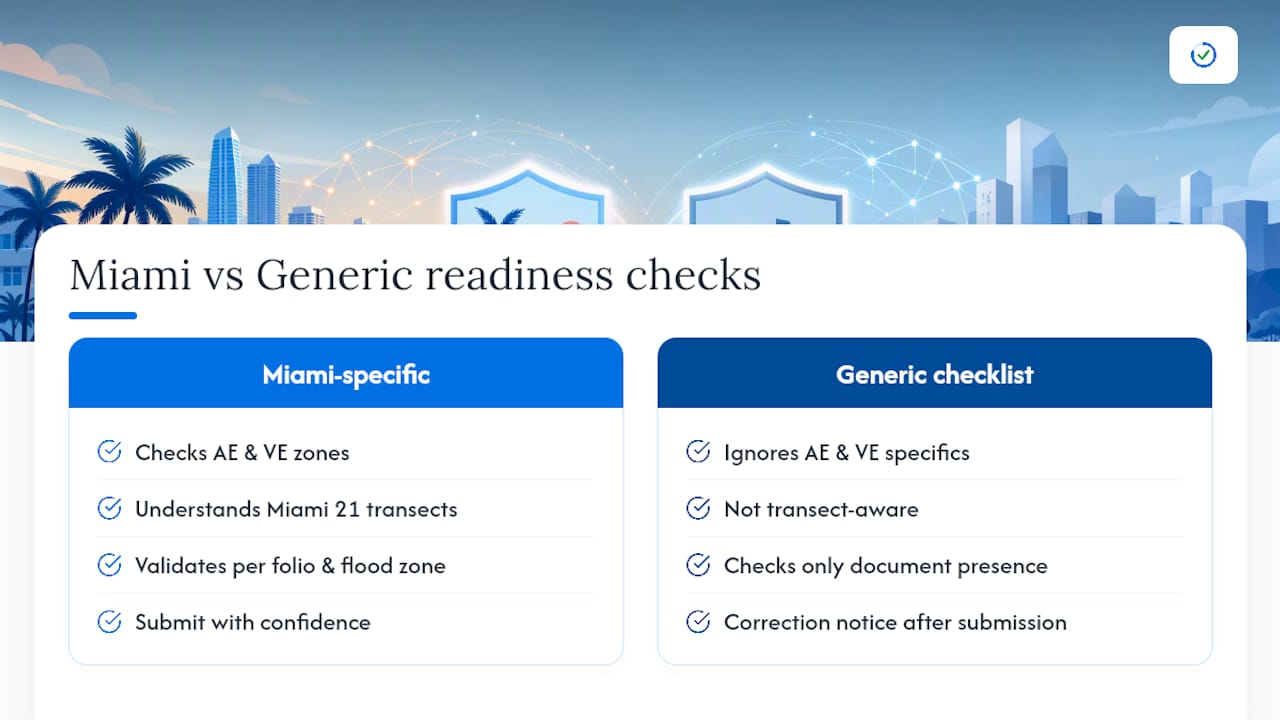
The standard advice is to “hire an expeditor” or “use permit software.” What that advice misses is that Miami-Dade’s rejection triggers are highly local. A missing elevation certificate in a Broward project is a nuisance. In Miami-Dade’s AE and VE flood zones, it stops your permit cold and resets your timeline by weeks. Miami 21’s transect-based zoning means a setback that is legal in one block can be a violation two blocks away.
Generic tools do not know any of that. They check whether your documents are present, not whether they are correct for your specific folio and flood zone. The difference between a readiness check grounded in Miami 21 data and a generic document checklist is the difference between submitting with confidence and discovering the problem after the county has already issued a correction notice.
For real estate investors, that timeline risk has a direct cost. A permit correction that adds three weeks to a renovation schedule affects carrying costs, contractor scheduling, and sometimes a closing date. The role of code compliance in closing deals is exactly why investors should treat permit readiness as part of their due diligence, not an afterthought.
Get a Miami-specific permit readiness check before you submit
Catching a missing elevation certificate or a Miami 21 setback violation before you file costs far less than a correction cycle after. Miamipermitai reviews your permit package against Miami-Dade’s actual requirements: Miami 21 zoning, FEMA flood zones, folio records, and DBPR contractor license status. You get a readiness score, a plain-language fix list, and post-submission tracking via email.
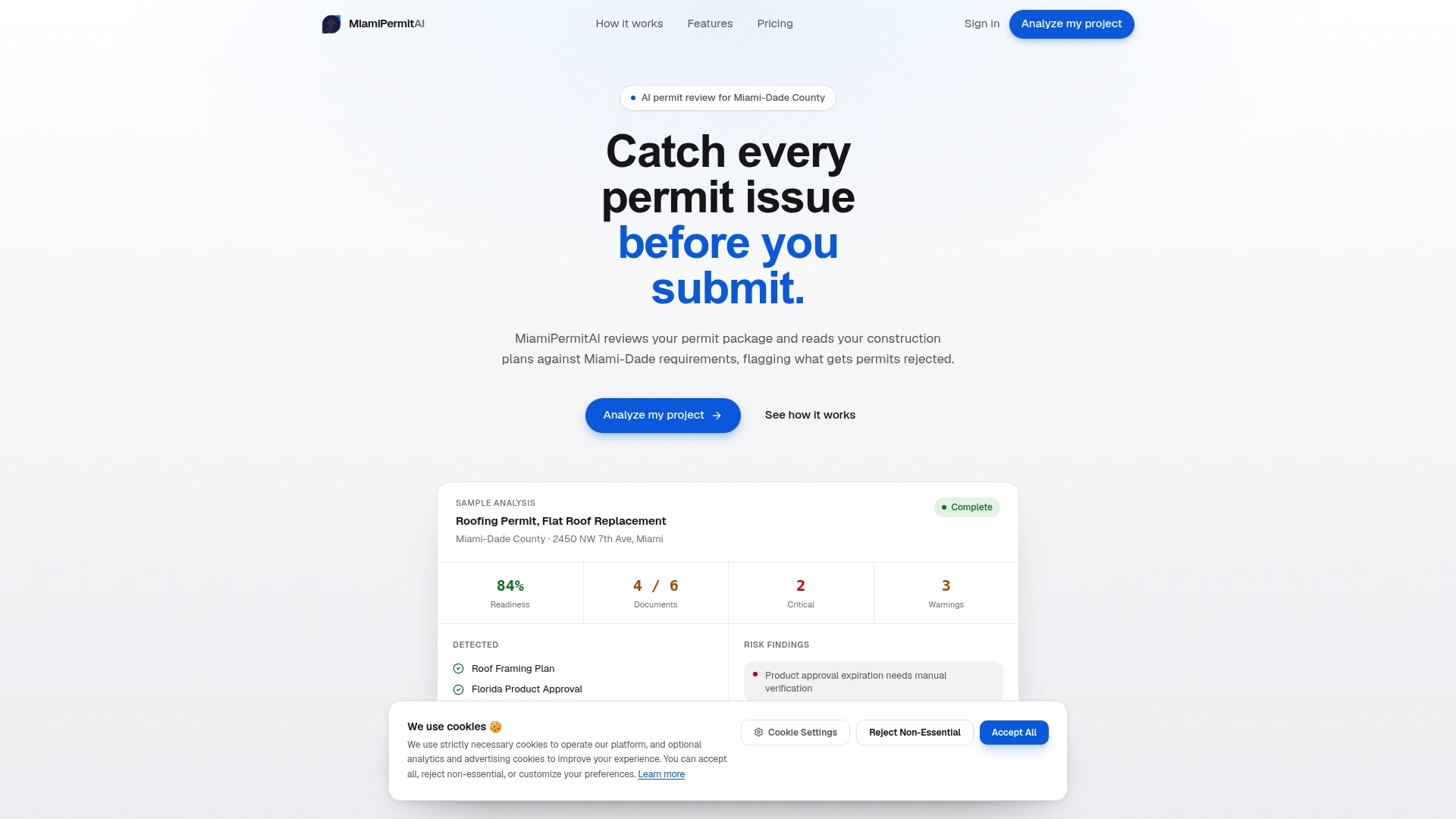
Start with a free preview to see what the platform flags on your package, then unlock the full report when you are ready to submit. One-time reports work for homeowners and investors; monthly subscriptions fit contractors pulling permits regularly. Check your permit readiness now before the county sees it first.
Sources
- Best Shovels.ai Alternatives for Building Permit Data (2026)
- PermitPortal — AI for Real Estate Development
- The 7 Best Construction Permit Tracking Software of 2026
- Permit Rockstar Funding - Debt Financing - Jacksonville | VCBacked
- Permit Rockstar Company Details: 1 Profile Signal | AeroLeads
Recommended
Is your permit package ready?
Run an AI readiness check against Miami-Dade requirements before you submit.
Try your first analysis freeThis article is general guidance and not legal, engineering, or official county advice. Always verify requirements with Miami-Dade County before submitting a permit.