
August 6, 2026
Reviuer.com Alternatives for Miami-Dade Permit Readiness

Reviuer.com Alternatives for Miami-Dade Permit Readiness
For Miami-Dade permit readiness, Miamipermitai is the strongest alternative to Reviuer.com because it ties every check to real local data: Miami 21 zoning, FEMA flood zones, folio property records, and Florida DBPR contractor license verification. The output is a numeric readiness score plus a prioritized fix list, not a generic compliance narrative. A free preview is available, with a paid unlock for the full report.
Before going further: Reviuer.com (the building code compliance tool) shares a name with at least one unrelated review-management product. Confirm you are evaluating the AI building-code solution, not a customer-review platform, before requesting a demo.
Pick by scenario:
- Miami-Dade projects: Miamipermitai, for local dataset coverage and post-submission permit tracking via public records
- Multi-jurisdiction or statewide projects: a national AI review service with broader code coverage
- Enterprise workflows with large plan volumes: a seat-based or API-integrated platform
- Single one-off reports: a per-report consultant or lightweight tool
Table of Contents
- How do these AI permit-review tools compare?
- What does each category of alternative actually deliver?
- How do you pick the right alternative?
- What do pricing models and turnaround times look like?
- How was this comparison compiled?
- Key Takeaways
- What contractors actually miss before submission
- Miamipermitai cuts rejection risk before you submit to Miami-Dade
- Useful sources and verification links
How do these AI permit-review tools compare?
| Dimension | Miamipermitai | Multi-jurisdiction AI service | Enterprise review platform | Per-report service |
|---|---|---|---|---|
| Jurisdiction coverage | Miami-Dade County (Miami 21, FEMA, folio records) | Florida or national, multiple jurisdictions | National, configurable | Varies by consultant |
| AI plan parsing | Yes, full permit package | Yes, code-section matching | Yes, custom rule sets | Limited or manual |
| Code checks | Zoning, setbacks, flood, contractor license, document completeness | Zoning, structural, energy code | Custom per jurisdiction | Varies |
| Readiness output | Numeric score + prioritized fix list | Pass/fail or narrative | Configurable report | PDF summary |
| Post-submission tracking | Yes, public Miami-Dade records + email updates | Rarely included | Sometimes | No |
| Supported permit types | Roof, electrical, plumbing, additions, renovations, mechanical, fences, decks | Varies | Varies | Project-specific |
| File formats | PDF (DWG/BIM: check with vendor) | PDF, sometimes DWG | PDF, DWG, BIM (enterprise tier) | |
| Pricing model | Subscription or one-time report; free preview | Subscription or per-report | Seat-based or API volume | Per-report |
| Best for | Licensed contractors, investors, homeowners in Miami-Dade | Statewide or national teams | Large portfolios, custom integrations | Occasional one-off users |
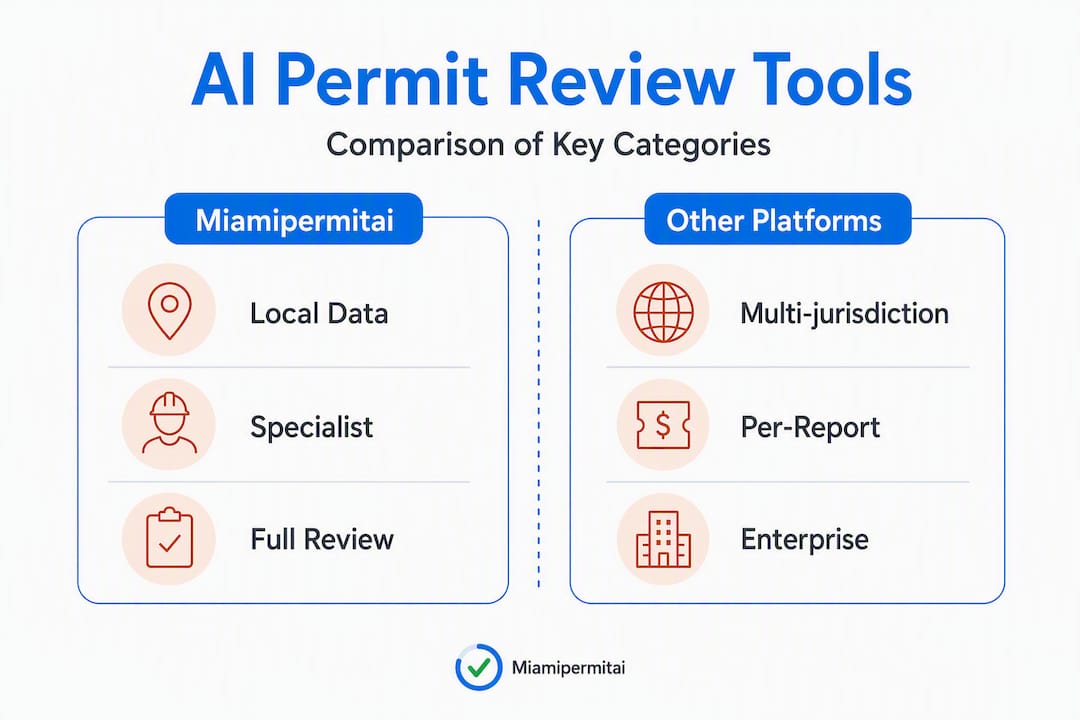
Local datasets tied to Miami 21 zoning and folio records reduce false positives that broader national models sometimes produce on Miami-Dade plans.
What does each category of alternative actually deliver?
Miamipermitai: Miami-Dade specialist
Miamipermitai reviews the full permit package before you submit to the county. It reads uploaded construction plans against Miami 21 zoning rules, checks FEMA flood zone requirements, cross-references folio property records, and verifies the contractor’s Florida DBPR license. The result is a readiness score and a line-item fix list in plain language. After you submit to Miami-Dade yourself, the platform polls public permit records and emails you status updates through approval. That post-submission tracking is rare among AI permit tools and cuts the administrative back-and-forth that slows most contractors down.
Best for: licensed residential and small commercial contractors, real estate investors, and homeowners working in Miami-Dade County.

Multi-jurisdiction AI review services
These platforms cover broader geographies, sometimes the entire state of Florida or multiple states. They are the right call when your portfolio spans counties or when a project sits outside Miami-Dade. The tradeoff is real: without local dataset integration (Miami 21 zoning, folio records), they produce more generic flags and miss county-specific nuances. Expect a pass/fail or narrative output rather than a scored, prioritized fix list tied to local code sections.
Per-report consultants and lightweight tools
For a single project you will never repeat, a per-report service or a consultant-reviewed PDF can be cost-effective. The downside is turnaround: automated checks return results almost immediately, while a human-verified report can take hours to a couple of days depending on plan complexity. These services rarely include post-submission tracking or exportable fix lists.
Enterprise platforms with custom integrations
Large architecture firms or developers managing dozens of active permits benefit from seat-based or API-volume platforms that connect to document management systems and permitting portals. DWG and BIM support is typically available at this tier, where it is often absent from entry-level tools. The cost and setup time are proportionally higher.
Pro Tip: Before committing to any platform, upload your actual permit package, not a sample plan the vendor provides. Many AI parsers only index the first few pages and miss sealed sheets or contractor signatures buried later in the document. Test with the full set: site plan, floor plans, structural details, and sealed sheets.
How do you pick the right alternative?
Jurisdiction data is the foundation
Ask every vendor which specific code sources their checks run against. “Miami-Dade compliant” means nothing without confirmation that the tool reads Miami 21 zoning, FEMA flood zone maps, and folio property records. A national model trained on generic IBC sections will flag things Miami-Dade does not require and miss things it does.
Readiness scoring method matters
A trustworthy vendor will show you a sample report and explain how the score is weighted: zoning items, flood checks, document completeness, contractor license status. If a vendor cannot produce a sample report or explain the rubric, that is a red flag. Opaque scoring prevents you from knowing whether a 78% readiness score means one missing document or a structural conflict.
File format and integration support
Most platforms parse PDF. Full DWG and BIM support is usually an enterprise-tier feature. If your workflow depends on DWG files, confirm support before signing anything. Ask whether the platform integrates with your document management system or the Miami-Dade permitting portal.
Vendor questions worth asking
Ask for the vendor’s accuracy rate on Miami-Dade plans specifically, not aggregate accuracy across all jurisdictions. Ask about data retention: how long are your uploaded plans stored, who has access, and can you export your correction history? Ask about SLA: what is the committed turnaround for a standard residential addition?
Red flags to walk away from
Pricing that escalates based on invitation or request counts can surprise a contractor whose volume grows mid-year. If the vendor cannot show you an exportable fix list (CSV or PDF with line-item corrections), your team cannot assign tasks or track completion. Walk away from any demo that only shows a generic sample plan rather than parsing one you provide.
Pro Tip: Set a minimum acceptance bar before any demo: the vendor must parse a real plan from your project file, show a scored output with a fix list, and demonstrate how corrections are exported. Any vendor that declines this test is telling you something.
What do pricing models and turnaround times look like?
Pricing falls into three types, and matching the model to your usage pattern matters more than the headline price.
| Pricing model | Best for | Typical turnaround |
|---|---|---|
| Subscription (monthly/annual) | Frequent users: active contractors with multiple permits per month | Instant to a few hours for automated checks |
| Per-report (one-time purchase) | Occasional users: homeowners, investors with one project | Hours to a couple of days for human-verified output |
| Seat-based or API volume | Enterprise: large firms, developers, plan review departments | Configurable; depends on integration |
Miamipermitai offers both a subscription for contractors running regular permit packages and a one-time report purchase for single projects, with a free preview before you pay for the full report and fix list. That structure lets a homeowner test the workflow without committing to a monthly fee.
On file formats: PDF is the baseline across all platforms. DWG and BIM support is common at the enterprise tier but limited or absent in entry-level and per-report tools. If your firm works in Revit or AutoCAD, confirm DWG/BIM support explicitly before a purchase decision.
How was this comparison compiled?
This comparison draws on vendor product pages, publicly available Miami-Dade building department resources, Miami 21 zoning documentation, and FEMA flood zone mapping data. Miamipermitai’s feature set is described from its own product documentation and landing page. Generic category descriptions for multi-jurisdiction and enterprise platforms reflect publicly documented capabilities common across that class of tool.
Accuracy in AI permit review is a precision-versus-recall tradeoff. A tool tuned for high recall flags every possible issue, including many false positives. A tool tuned for precision flags fewer items but with higher confidence. For Miami-Dade contractors, a platform grounded in local datasets produces fewer irrelevant flags than a national model, because it knows what Miami 21 actually requires rather than inferring from a generic code library.
Readers should validate any platform by running a real permit package through a vendor demo, not a canned sample. Parsing limits and UI quality become obvious within one real project.
Key Takeaways
Miamipermitai is the primary alternative to Reviuer.com for Miami-Dade permit readiness because local dataset integration, a scored fix list, and post-submission tracking address the specific gaps that cause rejections in Miami-Dade County.
| Point | Details |
|---|---|
| Test with a real plan | Upload your full permit package in every demo; parsers that only read the first pages will miss sealed sheets. |
| Verify local data sources | Confirm the vendor checks Miami 21 zoning, FEMA flood zones, and folio records, not just generic IBC sections. |
| Match pricing to usage | Subscription lowers per-report cost for active contractors; per-report works for one-off projects. |
| Demand exportable fix lists | CSV or PDF line-item corrections let your team assign and track fixes before resubmission. |
| Miamipermitai for Miami-Dade | Covers Miami 21, FEMA, folio records, DBPR verification, readiness scoring, and post-submission tracking. |
What contractors actually miss before submission
The permit packages that come back rejected in Miami-Dade share a short list of recurring problems: missing sealed plans, site data on the drawings that does not match the folio record, and a contractor license that has lapsed or was never verified. These are not exotic errors. They are the kind of thing a checklist should catch but often does not, because a checklist depends on the person running it knowing what to look for.
An AI readiness score works differently. It cross-references the uploaded package against the actual data sources: Miami 21 zoning for setbacks and use, FEMA flood zone maps for elevation requirements, folio records for property dimensions and ownership, and the DBPR database for contractor license status. The fix list that comes out is specific to those checks, not a generic reminder to “include all required documents.”
That said, AI readiness tools do not replace a licensed architect or engineer of record. Structural calculations, signed and sealed drawings, and professional judgment on complex site conditions still require a human. What AI does well is catch the administrative and compliance gaps before a reviewer at the county sees them, which is where most of the delay actually lives. For common permit submission mistakes that trigger corrections, the pattern is almost always a data mismatch or a missing document, not a structural error.
Miamipermitai cuts rejection risk before you submit to Miami-Dade
Fewer rejections, faster approvals, and no surprise correction letters: that is the practical case for running your permit package through Miamipermitai before it reaches the county. The platform checks Miami 21 zoning, FEMA flood data, folio property records, and Florida DBPR contractor verification in a single review, then returns a readiness score and a plain-language fix list you can act on the same day.
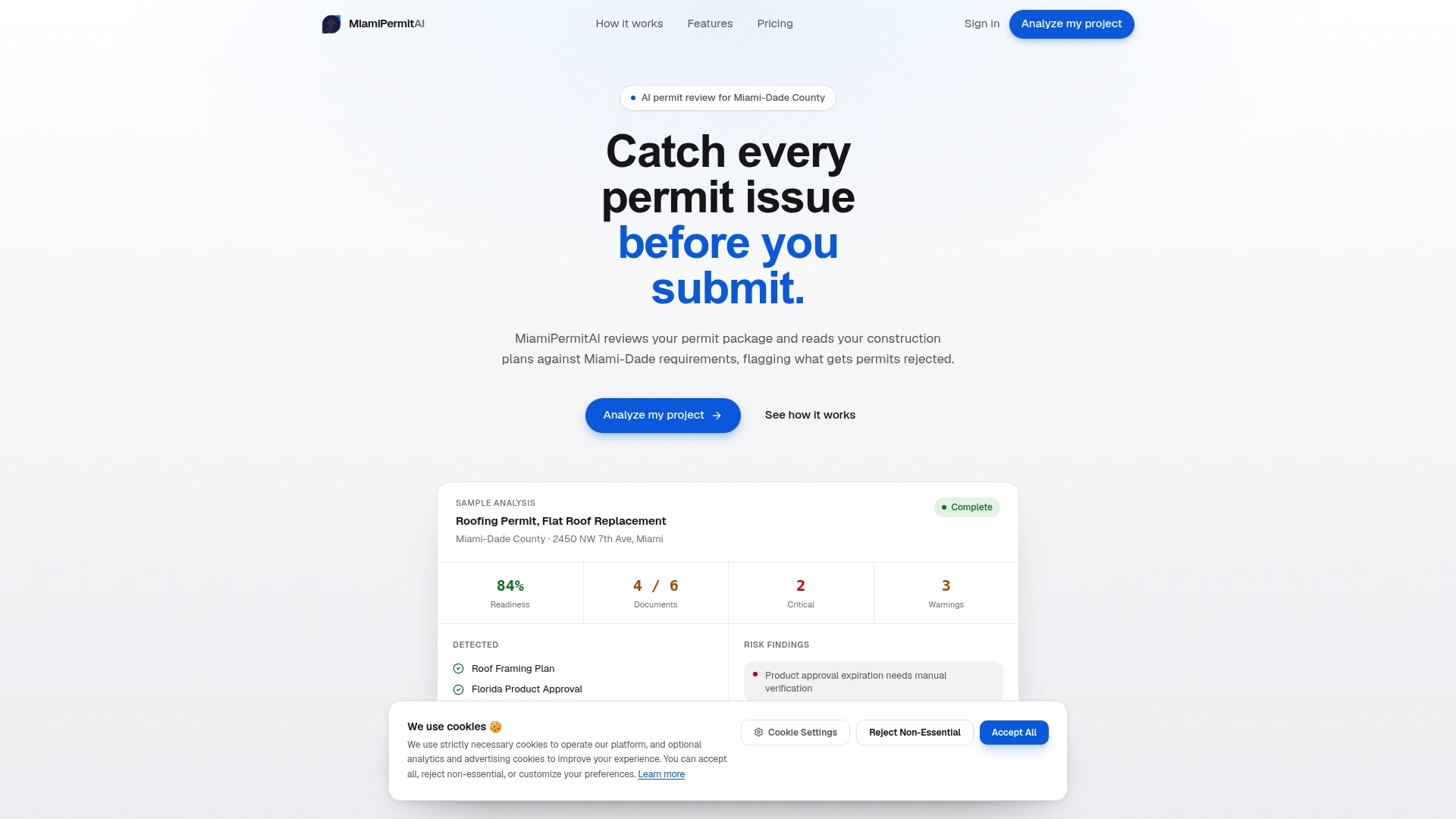
A free preview shows you the scope of the review before you pay anything. The full report, which includes the complete fix list and post-submission tracking, is available as a one-time purchase or through a monthly subscription for contractors running multiple permits. After you submit to Miami-Dade yourself, Miamipermitai monitors the public permit record and emails you status updates through approval.
Check your permit package now or request a sample report to see a readiness score on a real plan before committing.
Useful sources and verification links
- Miamipermitai product page: features, readiness scoring, pricing, and demo signup
- Miami 21 zoning code guide for contractors: local zoning rules and setback requirements
- Permit revision best practices for Miami-Dade: procedural guidance for resubmissions and corrections
- CodeComply.AI alternatives for US professionals: broader AI permit tool comparisons
- Miami-Dade County building department: public permit status records and official submission requirements
- FEMA Flood Map Service Center: flood zone maps and elevation data for Miami-Dade properties
- Miami 21 zoning code (official): official zoning atlas and code text for Miami-Dade
Recommended
Is your permit package ready?
Run an AI readiness check against Miami-Dade requirements before you submit.
Try your first analysis freeThis article is general guidance and not legal, engineering, or official county advice. Always verify requirements with Miami-Dade County before submitting a permit.