
July 28, 2026
Deed Restrictions and Permit Approvals for Miami-Dade

Deed Restrictions and Permit Approvals for Miami-Dade
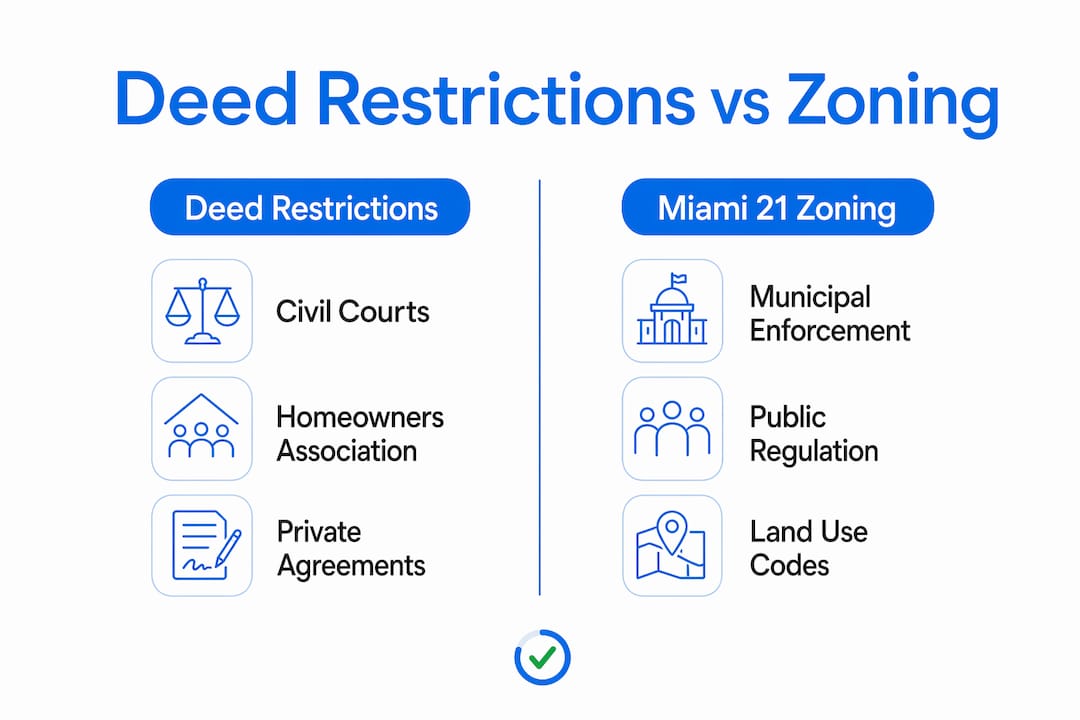
Recorded deed restrictions can stop a Miami-Dade project cold even after the county issues a permit. The Miami-Dade Building and Permitting Department reviews plans against public code and Miami 21 zoning rules. It does not clear private covenants. When the two conflict, the more restrictive requirement controls: a deed restriction requiring a setback larger than Miami 21 allowance overrides the Miami 21 setback, permit in hand or not.
The legal split matters. Deed restrictions are private agreements enforceable in civil court through injunctions, fines, or foreclosure. HOAs and neighboring owners bring those actions, not the county. Miami-Dade Building and Permitting issues permits based on public code only. A county approval gives you no shield against a covenant lawsuit.

Covenants run with the land and bind every future owner, even when the sale documents never mentioned them. They also rarely surface in routine folio or tax records; a dedicated covenant title search is the only reliable way to find them. Projects most often caught off-guard: fences, pools, second-story additions, accessory structures, and driveway changes, exactly the project types covenants commonly regulate.
Pre-permit checklist — run this before finalizing designs:
- Pull a covenant-specific title search (separate from the standard lien/tax search).
- Check Miami-Dade folio property records for recorded plat restrictions.
- Request a written letter of no objection from the HOA or architectural control committee. A template for that ACC approval request can save time.
- Verify Miami 21 setbacks, use, and height limits for your transect zone.
- Confirm FEMA flood zone requirements and DBPR contractor license status.
- Attach sealed plans, a current survey, and the HOA consent letter to the initial submittal.
| Factor | Private deed restriction | Miami 21 / public zoning |
|---|---|---|
| Enforced by | Civil courts, HOA, neighboring owners | Miami-Dade Building & Permitting |
| How to amend | Recorded consent of benefiting owners or court order | Variance, rezoning, or code amendment |
| Remedies for violation | Injunction, fines, foreclosure | Stop-work order, code fine |
| Does a permit override it? | No | N/A — permit IS the approval |
| Evidence to supply | HOA consent letter, recorded release, survey | Sealed plans, product approvals, DBPR license |
Changing a recorded covenant requires a recorded amendment signed by the benefiting owners or a court ruling. A municipal variance does not touch a private covenant. Legislative reform efforts exist, but covenants remain enforceable until a court or specific statute says otherwise. When HOA enforcement escalates, the path runs through litigation, not the permit office.
Pro Tip: Run the covenant title search before design finalization, not after. Securing a recorded release or written HOA consent before you submit to the county is the single most effective way to prevent a post-permit injunction that forces removal of completed work.
Including the HOA consent letter and a covenant review note with the initial permit submittal cuts review cycles and neutralizes late objections.
Table of Contents
Miamipermitai flags covenant gaps before you submit
Miamipermitai cross-checks your uploaded plans against Miami 21, folio property records, FEMA flood zones, and Florida DBPR licensing before you submit a single page to the county. It flags missing HOA consent letters, survey gaps, and common rejection triggers in one readiness report, with a plain-language list of what to fix and in what order. Upload your plans at miamipermitai.com and get your readiness score before the county ever sees the package.
Key Takeaways
Private deed restrictions and public zoning operate on separate legal tracks in Miami-Dade, and the stricter standard always governs regardless of which permit the county issues.
| Point | Details |
|---|---|
| Stricter rule controls | When a covenant requires a larger setback than Miami 21 allows, you must meet the more restrictive setback. |
| Permits don’t clear covenants | A Miami-Dade building permit provides no defense against a civil covenant enforcement action. |
| Search explicitly for covenants | Covenants rarely appear in folio or tax records; a dedicated title search is required before design. |
| Remedy requires recorded consent | Amending a covenant needs a recorded agreement from benefiting owners or a court order, not a variance. |
| Miamipermitai | Flags missing HOA letters and covenant-related document gaps before county submission. |
Recommended
Is your permit package ready?
Run an AI readiness check against Miami-Dade requirements before you submit.
Try your first analysis freeThis article is general guidance and not legal, engineering, or official county advice. Always verify requirements with Miami-Dade County before submitting a permit.