By the MiamiPermitAI team · August 17, 2026 · Updated September 30, 2026
Close an Open Permit Before Closing: What to Do Right Now
If a title search just turned up an open permit days before closing, do five things immediately: pull the exact permit number and current status from the county portal, notify the title company, lender, and closing attorney in writing, ask the listed contractor or permit holder whether the work is actually done, request a final inspection date from the building department, and if that date can’t happen before funding, ask your attorney to propose an escrow holdback instead of losing the closing date. Every one of those steps can happen the same day. None of them require you to solve the underlying permit problem before tomorrow morning.
The mistake that turns this into a crisis is treating it as one giant unsolvable issue instead of five small, sequential tasks. A permit that’s open because a final inspection never got scheduled is a completely different problem than a permit that’s open because someone built a room addition with no plans on file at all. You need to know which one you’re dealing with before you decide whether to fight for the original closing date or negotiate around it.
Here’s the priority order for the next few hours:
- Get the permit number, issue date, and current status from the county or municipal permit search. Screenshot it.
- Email the title company and lender the moment you have that screenshot, flagging the issue and asking how it affects the closing timeline.
- Contact the listed contractor or permit holder (their name is on the permit record) to ask if the work passed inspection and just wasn’t closed out on paper.
- Call the building department and ask directly: what’s needed to schedule a final inspection, and how soon can one happen?
- Loop in the closing attorney to start drafting escrow or holdback language in parallel, so you’re not scrambling if the inspection can’t happen in time.
Attach a small documentation packet to those first emails: the permit record screenshot, any inspection history you can pull, the name of the contractor on file, and photos of the completed work if you have them. Adjustors, title officers, and building department clerks all move faster when you hand them the paper trail instead of asking them to dig for it.
Then comes the fork in the road. If the building department can realistically schedule a final inspection before your funding date, that’s your best outcome. Push hard for that slot. If they can’t (and Florida municipalities often can’t turn around an inspection in three days), your energy should shift entirely to negotiating an escrow holdback or a short closing delay rather than hoping the permit magically closes itself.
Key Takeaways
Closing an open permit before a real estate transaction requires identifying the exact permit status immediately, notifying title and lender in writing, and choosing between an expedited final inspection or a negotiated escrow holdback.
| Point | Details |
|---|---|
| Act within hours, not days | Pull the permit number and status, then notify title, lender, and attorney the same day it surfaces. |
| Match the fix to the problem | A missed final inspection (2 to 4 weeks) is a different fix than an as-built plan revision (8 to 16+ weeks). |
| Escrow holdbacks keep deals alive | When a final inspection can’t happen in time, a negotiated holdback lets closing proceed on schedule. |
| Title searches don’t catch permits | A separate municipal permit search is required, searched by base address, not unit number. |
| Prevention beats negotiation | A MiamiPermitAI readiness review at listing time catches permit gaps months before they threaten a closing date. |
Table of Contents
- How to Close Open Permits Before Closing: The Step-by-Step Process
- How Long Does It Take to Close an Open Permit?
- What Are Your Options if the Permit Can’t Close in Time?
- What if the Work Was Never Permitted at All?
- Where to Search for Open Permits and What to Request
- How Permit-Readiness Reviews Prevent Last-Minute Surprises
- Fast Templates: What to Send Right Now
- What Brokers Get Wrong About Open Permits (and How to Fix It)
- When a Permit-Readiness Check Beats a Last-Minute Scramble
- Where to Verify Permit Status and Find Municipal Forms
- Frequently Asked Questions
- Sources
How to Close Open Permits Before Closing: The Step-by-Step Process
Closing an open permit is a procedural task, not a mystery. It follows roughly the same sequence in most jurisdictions, even though the paperwork and terminology change from county to county.
- Search the municipal permit record. Use the property’s base building address rather than a unit number if it’s a condo or multi-unit building. Some permit portals only index records at the building level, so searching by unit number alone can produce a false negative.
- Confirm who holds the permit and what scope it covers. The permit card lists the contractor of record, the work description, and the issue date. This tells you whether you’re dealing with a roof replacement that never got its final inspection or a kitchen remodel that expanded into unpermitted electrical work.
- Contact the permit holder or contractor directly. If they’re still licensed and reachable, they’re usually the fastest path to a closed permit since they already know the project.
- Request the final inspection. Most municipalities require you to call or submit a request online, sometimes with a small scheduling fee.
- Handle corrective work if the inspector flags something. This is where timelines stretch. A failed inspection means another round of repairs and another inspection date.
- Confirm the closed status in the municipal record. Don’t take a contractor’s word for it. Recheck the online portal or call the building department to verify the permit shows as finaled, not just “inspection scheduled.”
At each stage, keep a folder (physical or digital) with the permit card, any inspection history, plans or as-built drawings if the project required them, the contractor’s license number, receipts for corrective work, and dated photos of the completed job. Title companies and buyer’s attorneys will ask for this exact packet later, and having it ready shaves days off the back and forth.
Some municipalities complicate this further. Orlando’s closeout process, for example, requires a digital plan submittal followed by a signed and sealed paper set before the final inspection can even be scheduled, with review queues that commonly run around 10 business days. If your municipality works this way, that’s 10 days minimum before an inspector even shows up, not 10 days until closure.
Pro Tip: Call the building department and ask specifically for the inspector who handled the most recent visit on that permit, by name if you can get it. Inspectors remember their own projects far better than a generic front-desk clerk does, and going straight to them skips a round of paperwork re-routing that eats two or three days on its own.
If the project required engineered drawings, our guide on as-built drawings and permit closeout walks through when municipalities demand them and how that document requirement changes your timeline.
How Long Does It Take to Close an Open Permit?
The honest answer is: it depends entirely on why the permit is still open. A missed final inspection on a straightforward job is a completely different animal than a permit that needs to be superseded because the original contractor vanished.
Scenario one: final inspection only. The work is done, it’s code compliant, and someone simply never scheduled or passed the last inspection. This is the fastest path, typically 2 to 4 weeks, and the only real cost is a modest reinspection or scheduling fee.
Scenario two: expired permit with minor corrections. The permit lapsed, or the inspector found small items to fix. Expect 6 to 12 weeks or more, since it usually involves a renewal step, contractor scheduling for the fix, and a second inspection slot.
Scenario three: as-built drawings or plan revision required. The completed work doesn’t match the original plans, or no plans exist at all. This is the slow lane, often 8 to 16 weeks or longer, because it usually needs a licensed professional to prepare new drawings and the municipality to run a full plan review before scheduling anything.
| Scenario | Typical timeline | Typical cost drivers |
|---|---|---|
| Final inspection only | 2 to 4 weeks | Reinspection or scheduling fee |
| Expired permit, minor corrections | 6 to 12+ weeks | Renewal fee, contractor labor for corrections |
| As-built or plan revision required | 8 to 16+ weeks | Plan review fee, engineering/drafting fees, corrective construction |
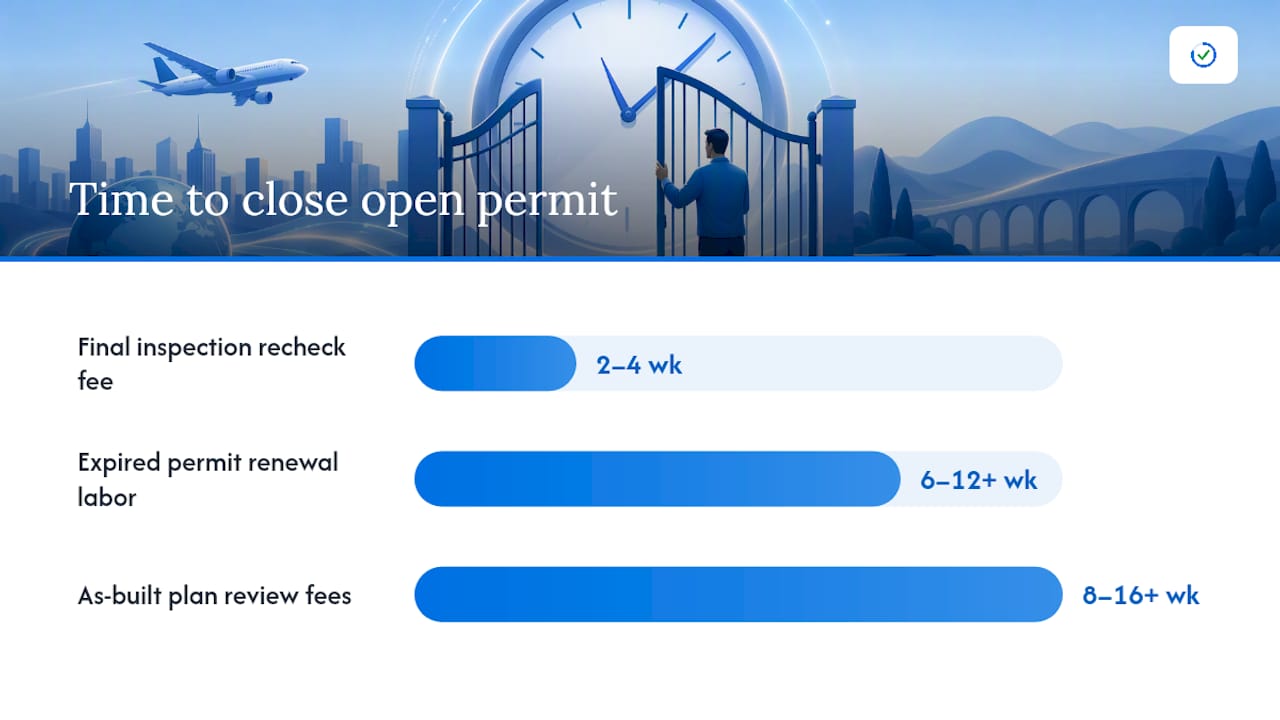
Several factors push these ranges longer: a municipal backlog during peak building season, a permit that’s more than a few years old, missing or unreachable contractors, and any requirement for a licensed professional to redraw plans from scratch. Superseding applications, where a new licensed professional takes over responsibility for an abandoned permit, sit firmly in that 8 to 16 week range or beyond in busy jurisdictions.
Inspectors also tend to bump legacy closeout requests behind active construction projects on their schedule, which is exactly why waiting until the week of closing is the riskiest possible timing. An inspector juggling a full calendar of active job sites has little incentive to prioritize a permit from three years ago over a project that’s holding up someone’s current construction schedule.
What Are Your Options if the Permit Can’t Close in Time?
An open permit at closing doesn’t automatically kill the deal. It usually shifts the conversation from “can we close” to “how do we close.” Four outcomes tend to happen, in roughly this order of frequency:
- The seller resolves the permit before closing, either by scheduling the final inspection in time or paying for expedited processing.
- The buyer accepts an escrow holdback, letting the deal close while a set amount of funds sits with the title company until the permit is closed.
- The parties agree to push the closing date back by a defined window, typically a few weeks.
- In rarer cases, particularly where the permit involves structural or safety issues the lender won’t overlook, the deal falls through entirely.
Escrow holdbacks are the workhorse solution here. The mechanics are simple: the title company holds back a negotiated dollar amount from the seller’s proceeds, and that money only releases once the seller provides proof the permit shows as closed in the municipal record. A typical attorney instruction might read something like: “Seller and Buyer agree that $X shall be held in escrow by [Title Company] pending final closeout of Permit #[number], to be released to Seller upon written confirmation of closed status from [Municipality] Building Department, or applied to corrective work if closure is not achieved within [timeframe].” That’s illustrative language, not something to copy verbatim into a real contract, so run the actual wording past your attorney.
Cost responsibility defaults to the seller in most transactions, since the open permit existed before the sale, but this is negotiable. Buyers commonly request credits or holdbacks rather than insisting the seller personally chase down an inspector. Lenders and title companies respond very differently depending on what kind of permit is open: a cosmetic permit like a fence or a water heater swap rarely spooks anyone, while a structural permit tied to a room addition or a load-bearing wall change can trigger a lender’s flat refusal to fund until it’s resolved.
Loop these people in immediately once you know a permit is open:
- The title officer, who needs to know before they issue a clean title commitment.
- The buyer’s lender, since some loan products won’t fund with unresolved permits above a certain risk threshold.
- The buyer’s attorney, who will want to draft or review any escrow language before signing off.
- The listing agent and buyer’s agent, so nobody blindsides the other side mid-negotiation.
Our piece on code compliance’s role in closing real estate deals goes deeper into how these situations typically resolve when code violations, not just missing paperwork, are involved.
What if the Work Was Never Permitted at All?
This is the harder version of the problem, and it splits into two very different paths depending on one question: does the work meet current code?
If an inspector determines the work is unsafe or noncompliant, corrective construction is not optional. You (or the seller) will need a licensed contractor to bring the work up to current standards before any permit can close, and that often means opening up walls or ceilings that were already finished.
If the work was simply never done under permit at all, meaning someone built something without ever pulling paperwork, you generally have two routes. You can withdraw or void the permit application if it turns out no work actually happened under it, which some municipalities allow through a notarized request form with an administrative fee. Or, more commonly for completed unpermitted work, you apply for a new permit after the fact, sometimes with as-built drawings and an engineer’s letter certifying the existing construction meets current code.
The real risk with unpermitted work isn’t just the fine. It’s that a lender can refuse to fund entirely, a title company can flag the issue as an objection that has to clear before closing, and an insurer can later deny a claim tied to that unpermitted portion of the structure. None of those parties care whether the work “looks fine.” They care whether it’s on record.
Watch for these specific exposure points:
- Lender refusal to fund if the unpermitted work is structural or affects habitability.
- Title objections that must clear before the title company will issue a clean policy.
- Requirements to meet current code, not the code in effect when the work was originally done, which can mean more extensive (and expensive) corrections than expected.
- Fines or penalties assessed by the municipality for working without a permit.
- Insurance claim exposure, since a future claim tied to unpermitted work can be partially or fully denied.
When the issue is genuinely unsafe, pause the closing rather than negotiate around it. When it’s a paperwork gap on work that’s otherwise sound, a negotiated escrow remains a reasonable way to keep the deal moving while the after-the-fact permit process plays out.
Where to Search for Open Permits and What to Request
A standard title search is not a permit search. This trips up more buyers and agents than almost anything else in this process, because title insurance covers ownership and lien issues, not whether the seller’s deck addition ever got inspected.
To actually confirm permit status, go to the source:
- Search the county or municipal permit portal directly, using the base street address. Miami-Dade’s permit search tools are a useful example of what these county-level portals typically offer, including e-permitting status lookups and inspection scheduling.
- Strip unit numbers when searching condo or multi-unit properties. Many portals file permits under the building’s base address, and searching a unit number alone can miss records entirely.
- Call the building department directly if the online portal shows incomplete or ambiguous results, which happens more often with older permits scanned from paper records.
When you do reach a live person at the building department, request these specific documents:
- The permit card showing issue date, scope, and contractor of record.
- The inspection report or log, showing which inspections passed and which are outstanding.
- As-built drawings, if the project required them for closeout.
- Plan review comments, if a revision or correction is pending.
- Any permit withdrawal or void forms, if that’s the applicable path.
- Correspondence from a permit expediter, if one was involved in the original project.
On the phone, ask three things pointedly: the current status of the permit, the date of the last inspection performed, and the name of the inspector who handled it. Municipal offices sometimes require a small fee or notarized signature for certain document requests, particularly withdrawal forms, so ask about that up front rather than discovering it after you’ve submitted a package. Some jurisdictions want submissions by email, some use a digital portal like ProjectDox, and a few still require physical delivery, so confirm the accepted method before you send anything.
How Permit-Readiness Reviews Prevent Last-Minute Surprises
The single biggest lever you have here isn’t a faster inspector or a more cooperative building department. It’s timing. Open permits typically surface during a title search about 10 to 14 days before closing, and by that point you’re negotiating under pressure instead of solving a problem calmly. Catching the same issue at listing, or even earlier, gives you months of runway instead of days.
This is where a permit-readiness review earns its keep. Rather than waiting for a title company to flag a problem, the review checks the permit history and current project documentation against what the municipality actually requires, before it becomes a closing emergency. A thorough review typically covers a document checklist against what the county expects, a comparison of what’s on file versus what’s actually built (the as-built gap), verification that any listed contractor’s license is active, and flagging of missing sealed plans or engineering documents before they hold up a closeout.
The right moments to run one:
- Before listing a property, so any open permits surface with months of runway instead of days.
- Before making or accepting a major offer, especially on older homes with a history of owner-done renovations.
- Before starting new renovation work, so a new project doesn’t stack a fresh permit issue on top of an existing open one.
MiamiPermitAI’s readiness review pulls directly from Miami-Dade sources, including Miami 21 zoning, FEMA flood zone data, folio property records, and Florida DBPR contractor license verification, then returns a readiness score with a specific fix list in plain language. That’s meaningfully different from a generic checklist, because it’s checking against the actual local requirements a Miami-Dade building department will enforce, not a national template.
One limitation worth stating plainly: no readiness platform replaces the municipal approval itself. A readiness review tells you what’s likely to cause a rejection or a stalled closeout before you submit or list. The actual final inspection, sign-off, and closed status still come from the building department, every time.
Pro Tip: Run a permit-readiness check the same week you sign a listing agreement, not the week you accept an offer. By the time you have an accepted offer, you’re already on the clock, and any correction work you discover then competes with the buyer’s own inspection and financing deadlines.
Fast Templates: What to Send Right Now
If you’re staring at an open permit with a closing date bearing down, here’s the order to gather materials and the actual language to send.
Gather these first, in this order: the title company’s written notice flagging the permit, the exact permit number, the contractor’s name and license number from the permit card, and any photos showing the completed work.
1. Email to the building department, requesting status confirmation and an expedited final inspection:
Subject: Status Request and Final Inspection Scheduling, Permit #[number], [property address]
I’m reaching out regarding Permit #[number] for [property address], currently pending closing on [date]. Could you confirm the permit’s current status and the date of the last inspection performed? If a final inspection is still outstanding, I’d like to request the earliest available slot given the closing timeline. Please let me know what documentation or fees are needed to move this forward.
2. Email or call script to the title company and lender, proposing an escrow holdback:
Given the timeline, we’d like to propose an escrow holdback of $[amount] to allow closing to proceed on schedule, with funds released upon written confirmation from [municipality] that Permit #[number] shows closed status. We’re happy to provide the permit record, inspection history, and contractor documentation to support this arrangement.
3. Message to the contractor listed on the permit, asking them to schedule the missed final:
We’re finalizing the sale of [address] and see Permit #[number], which you pulled for [scope of work], is still showing open with the county. Would you be able to schedule the final inspection this week? Happy to coordinate access to the property or provide any documentation you need.
A real estate attorney can tighten any of this language into binding contract terms; understanding what an attorney handles during closing helps you know when to loop them in versus when a straightforward email will do.
What Brokers Get Wrong About Open Permits (and How to Fix It)
The three most common mistakes aren’t complicated, and none of them require special expertise to avoid. First, agents and sellers wait for the buyer’s title search to surface the issue instead of checking permit history at listing, which is precisely backward given how tight that window is once a buyer’s search flags a problem. Second, people assume a clean title search means clean permits, when a standard title search checks ownership and liens, not whether a 2019 pool permit ever got its final inspection. Third, sellers rarely keep permit records with the rest of the property file, so when a question comes up, nobody can produce the permit card or contractor name without a scramble.
The fix for all three is procedural, not technical. Brokers who build a permit check into their listing intake process, the same way they build in a pre-listing inspection or a title search, catch these issues while there’s still time to fix them without drama. The core point is simple: the transactions that blow up over permits are rarely the ones where a permit was open. They’re the ones where nobody knew it was open until 10 days before funding.
Timing can make this play out two very different ways. A seller who runs a permit check before listing might discover an open pool permit from a previous owner, months before any buyer is in the picture. They can schedule the final inspection, close it out, and keep the topic from coming up during the sale. Compare that to the far more common version: the same discovery made by a buyer’s title company two weeks before closing, forcing a rushed escrow negotiation under real time pressure. Same permit, same fix, completely different experience for everyone involved, purely because of when it surfaced.
When a Permit-Readiness Check Beats a Last-Minute Scramble
A rushed final inspection, an emergency contractor call, and a negotiated escrow holdback all cost money and stress that a permit-readiness review, done months earlier, usually avoids entirely. Compare the numbers yourself: a corrective construction job under time pressure often costs more than the same work scheduled calmly, and an escrow holdback ties up part of the seller’s proceeds for weeks or months after closing.
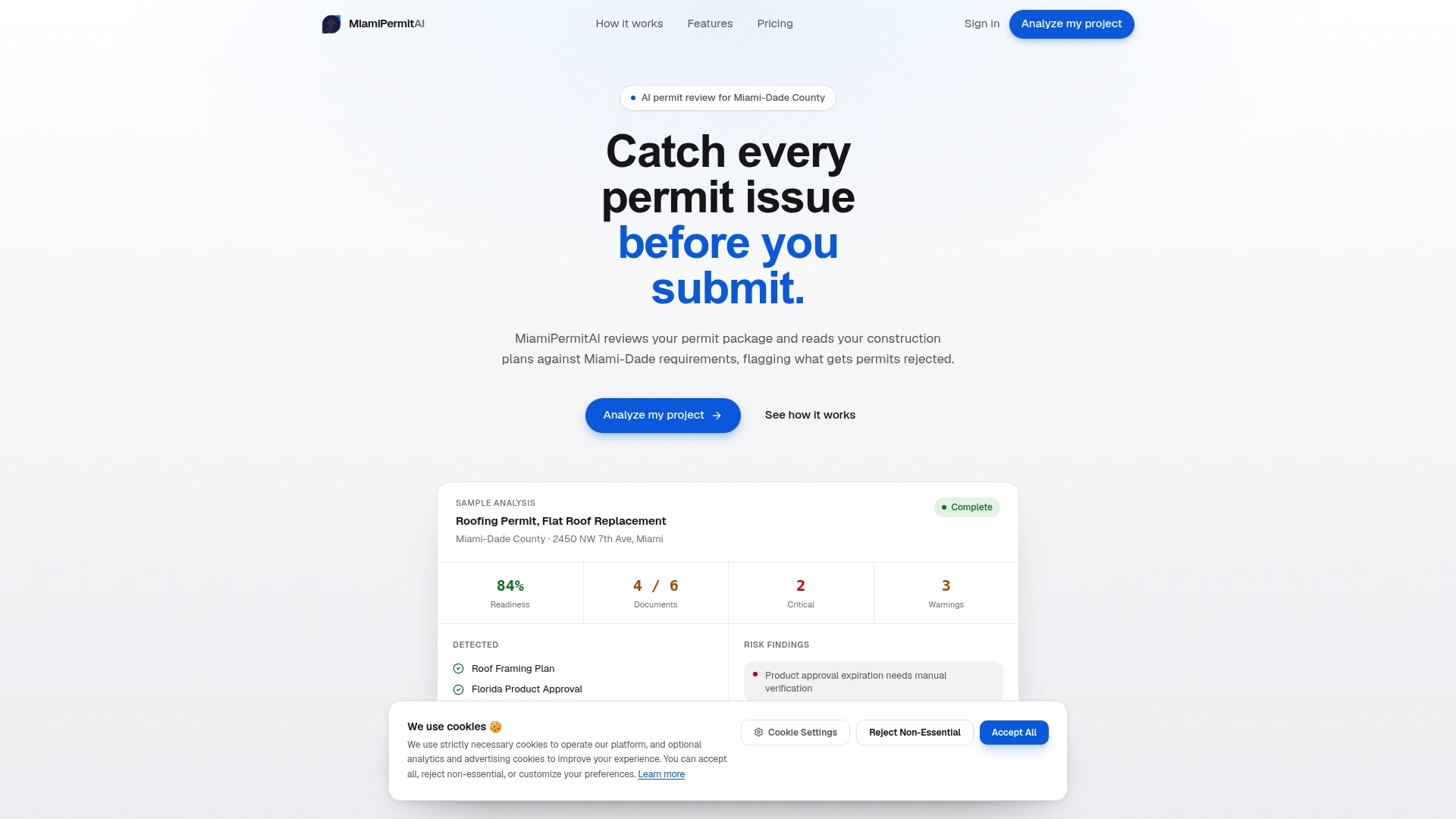
MiamiPermitAI is built specifically for Miami-Dade property owners, agents, and contractors who’d rather catch a permit problem in week one of listing than week two before closing. A typical readiness review returns a clear score, a fix list written in plain language instead of building-code jargon, the specific sealed documents a project needs, and guidance on exactly who to call at the county to move things forward. It checks your project against Miami 21 zoning, FEMA flood zone requirements, folio property records, and Florida DBPR contractor licensing data, all specific to Miami-Dade rather than a generic national checklist.
One thing worth being clear about: the building department still issues the actual approval and performs the final inspection. What a readiness review does is strip out the guesswork before you submit, so you’re not finding out about a missing sealed document the week of your closing. If you’re listing a property, planning a renovation, or just want to know where a permit stands before a buyer’s attorney asks, check your project’s readiness before it becomes a closing-week emergency.
Where to Verify Permit Status and Find Municipal Forms
Start with the county or municipal permit search tool for the specific property, since these portals are updated more frequently and more accurately than any third-party aggregator site.
- Miami-Dade County’s permit portal for status lookups, e-permitting information, and inspection scheduling.
- Municipal closeout guidance pages, such as Boston’s close-permit process document, which outlines a typical confirmation workflow after a final inspection.
- Superseding application guidance, such as NYC’s OPPN 03/98, for cases where the original permit holder is unreachable.
| Resource type | What it’s used for | Where it typically lives |
|---|---|---|
| County permit portal | Status lookup, inspection scheduling | County or city building department website |
| Closeout/confirmation forms | Confirming final sign-off in the record | Building department or code enforcement office |
| Withdrawal/void forms | Voiding a permit with no completed work | Building department, often notarized |
| Superseding application forms | Assigning a new licensed professional to finish an abandoned permit | Building department, sometimes requires attorney review |
Before you rely on any phone number or portal, verify current business hours and whether the office offers an email or case-number system as a backup. Many building departments run reduced phone hours but still respond to email inquiries within a day or two, which matters when a closing deadline doesn’t care whether the office is open.
Frequently Asked Questions
Can you close on a house with an open permit? Yes, in many cases. It depends on the lender and title company’s risk tolerance for that specific permit type. Cosmetic permits rarely block a closing, while structural or safety-related open permits often require resolution or an escrow holdback before a lender will fund.
Who pays to close an open permit before closing, buyer or seller? The seller typically bears the cost, since the permit predates the sale, but this is fully negotiable between the parties and often gets resolved through a credit or escrow holdback rather than a strict rule.
Does title insurance cover open permits? No. A standard title search checks ownership and liens, not municipal permit status. You need a separate permit search through the county or city building department to confirm whether a property has open permits.
How do you find out if a permit is closed? Search the municipal or county permit portal using the property’s base address, or call the building department directly and ask for the current status, the date of the last inspection, and the inspector’s name.
What happens if a permit can’t be closed before closing? The parties typically negotiate an escrow holdback, where a set amount from the seller’s proceeds is held until the permit shows as closed, or agree to a short closing delay. In rare cases involving significant safety issues, the sale can fall through entirely.
This article provides general information about permit closeout procedures and is not a substitute for advice from a licensed attorney, contractor, or your local building department regarding your specific transaction.
Sources
- Copy of Close Permit
- OPPN 03/98 — Superseding Applications (NYC Department of Buildings)
- Permits - Miami-Dade County
Recommended
Is your permit package ready?
Run an AI readiness check against Miami-Dade requirements before you submit.
Start your first projectThis article is general guidance and not legal, engineering, or official county advice. Always verify requirements with Miami-Dade County before submitting a permit.