By the MiamiPermitAI team · August 18, 2026
What Does a County Inspector Actually Do for Your Permit?
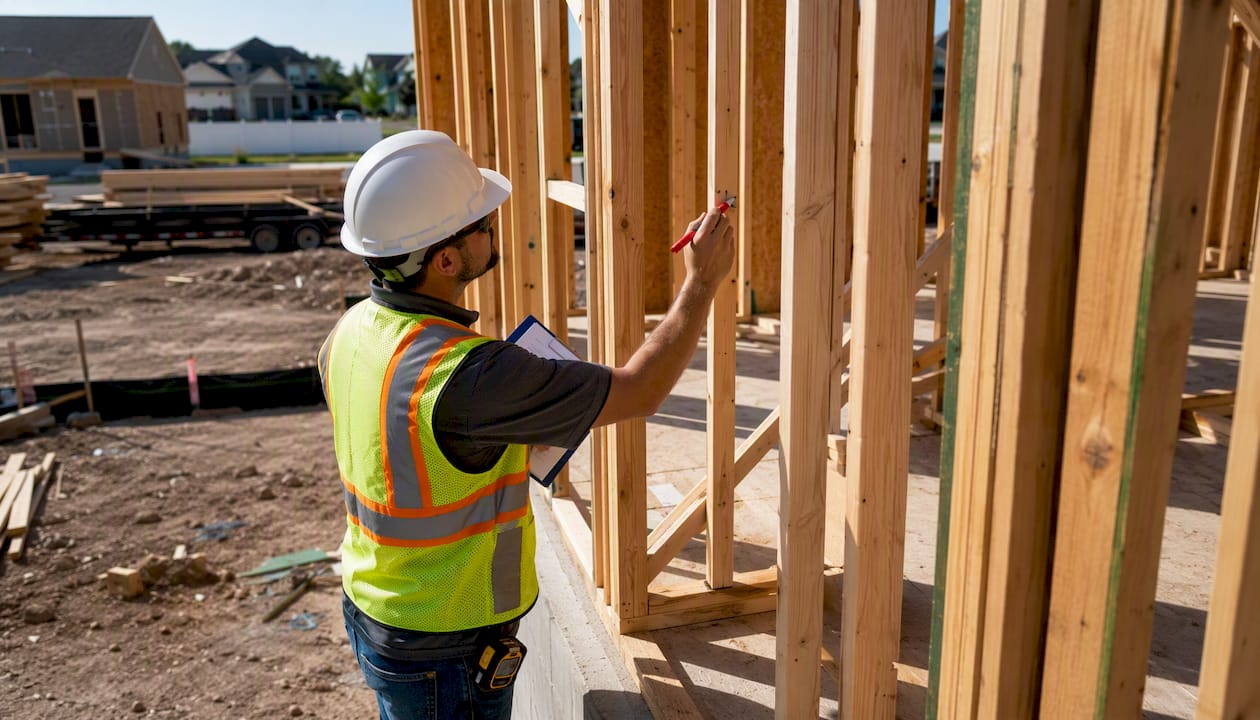
A county building inspector’s job is to verify that permitted work matches approved plans and adopted codes, not to design, fix, or advise on construction. Their findings come from the International Code Council’s model codes, local amendments, and the stamped plan set your permit was issued against. On site, that verification role breaks into a few concrete jobs:
- Confirm the work on the ground matches the approved plans
- Check code compliance at each construction stage
- Document deficiencies and issue correction notices
- Issue stop-work orders or red tags when work is unsafe or unpermitted
- Sign off on final inspection before occupancy
An inspector confirms compliance. They do not consult on your framing layout or tell your electrician how to run a circuit. That distinction shapes everything else in this article.
Key Takeaways
A county inspector’s core job is verifying that built work matches approved plans and adopted codes, using inspections, documentation, and stop-work authority to enforce compliance.
| Point | Details |
|---|---|
| Inspectors verify, they don’t consult | Their job is code compliance against approved plans, not design or construction advice. |
| Inspections follow construction stages | Expect visits at initial, foundation, rough-in, insulation, and final stages. |
| Keep documents visible on site | Post the permit card and keep stamped plans accessible for every inspection. |
| Penalties for skipping permits are steep | Some counties fine violators up to three times the permit cost and require reopening finished work. |
| County and private inspectors serve different roles | One enforces code; the other evaluates condition for buyers and sellers. |
| Catch errors before submission | Miamipermitai reviews Miami-Dade permit packages against zoning, flood, and licensing data to flag issues before the county does. |
Table of Contents
- The Role of a County Inspector in the Home Permit Process
- What Are the Typical Stages of a Home Inspection?
- What Do Inspectors Check on Every Visit?
- How Do You Prepare a Job Site for Inspection?
- What Happens If You Skip a Permit or Fail an Inspection?
- County Inspector vs. Private Home Inspector: What’s the Difference?
- How Do You Schedule, Reschedule, or Cancel an Inspection?
- What Should Be on Your Permit-Readiness Checklist?
- Why Cooperation Beats Confrontation With Your Inspector
- A Faster Way to Catch Permit Problems Before the County Does
- Frequently Asked Questions
- Sources
The Role of a County Inspector in the Home Permit Process
County inspectors carry legal enforcement authority most homeowners never think about until a red tag shows up on their door. According to the Bureau of Labor Statistics, building inspectors enforce codes, review plans, conduct field inspections, document compliance, and issue stop-work orders when a project violates permit terms or safety rules.
Their day-to-day duties include:
- Verifying that field conditions match the approved, stamped plan set
- Inspecting structural, electrical, plumbing, and mechanical work at defined stages
- Recording pass/fail results in the county’s permit tracking system
- Issuing correction notices for deficiencies found during a visit
- Issuing stop-work orders or red tags for unpermitted or unsafe work
Some counties, like Pinellas County, extend this authority beyond buildings into utilities and public works, with the power to red tag anything installed without the correct permit. That authority has real limits, though: an inspector can deny occupancy over a failed final, but they cannot approve a design change on the spot. Any deviation from approved plans usually needs a revision submitted back through plan review first.
Pro Tip: If an inspector flags an issue, ask for the specific code section they’re citing. It speeds up your conversation with your contractor and prevents the same mistake on the next inspection.
Inspectors verify compliance rather than provide construction consultancy. Handing out design advice would expose the county to liability it has no interest in taking on.
What Are the Typical Stages of a Home Inspection?
Inspections follow the construction timeline, not a fixed calendar. Each stage gets triggered by a specific milestone, and skipping ahead usually means an inspector turns you away at the door.
- Initial or site inspection. Happens near permit issuance to confirm site conditions, setbacks, or erosion controls match the plan.
- Foundation and footing. Scheduled once forms and rebar are in place but before concrete gets poured.
- Rough-in inspection. Covers structural framing, electrical, plumbing, and HVAC once those systems are installed but still exposed.
- Insulation and energy inspection. Confirms insulation values and air sealing before drywall goes up.
- Final inspection. Confirms the finished project matches the approved plans and clears the way for occupancy.
The Seattle Department of Construction & Inspections/construction-permit%C2%A0–new-building-single-family-residential%C2%A0or-duplex) lays out this exact sequence for single-family projects, and most counties mirror it closely. A simple tracking checklist:
- Mark each stage on your permit card as it’s scheduled
- Confirm the prior stage passed before booking the next
- Keep copies of every inspection result for your records
What Do Inspectors Check on Every Visit?
Inspectors work trade by trade, and each trade has its own quick-fail items. Structural framing gets checked for proper nailing patterns, header sizing, and connector hardware. Electrical rough-in gets checked for box fill, grounding, and wire gauge matching the panel schedule. Plumbing rough-in gets pressure-tested for leaks before it’s buried in a wall. Mechanical gets checked for duct sizing and combustion air on gas appliances. Roofing tie-ins, gas line connections, and site drainage near the right-of-way get their own look depending on the project.
Before any of that starts, the inspector needs three things visible on site:
- The approved permit and permit card posted where it’s visible from the street
- The stamped, approved plan set on site for reference
- Clear address numbers so the inspector can confirm they’re at the right property
Quick-fail items worth knowing in advance:
- Missing or unposted permit card
- No approved plans available for comparison
- Work concealed before the applicable rough-in inspection happened
- Obvious code violations like undersized headers or missing GFCI protection
How Do You Prepare a Job Site for Inspection?
Preparation is almost entirely about visibility and access. An inspector can’t verify work they can’t see, and they won’t guess on your behalf.
- Post the permit and keep the approved plan set on site, ideally in a weatherproof sleeve
- Leave rough-in work exposed and accessible until it passes
- Clear pathways to electrical panels, crawl spaces, and attics
- Confirm the address is visible from the road
- Make sure the space is safe to walk through, with ladders and lighting where needed if requested
The permit holder or their authorized contractor should be on site or reachable, since the inspector may need someone to open a panel or answer a question about the scope of work. A homeowner permit guide from Los Angeles confirms that missing documentation or blocked access can trigger extra charges, not just a delayed inspection.
Pro Tip: Do a five-minute self-walkthrough with your own copy of the plans before the inspector arrives. Catching an obvious miss yourself costs nothing; catching it during the actual inspection can cost a re-inspection fee. A document checklist for addition permits is a useful reference for what “complete” looks like on paper.
What Happens If You Skip a Permit or Fail an Inspection?
Skipping a permit rarely saves money in the long run. According to the Bureau of Labor Statistics, unpermitted or noncompliant work can lead to fines up to multiple times the original permit cost, plus orders to dismantle finished work so an inspector can verify what’s hidden behind it.
Common consequences stack quickly:
- Fines may scale with the value of the permit
- Forced demolition of drywall, siding, or flooring to expose concealed work
- Stop-work orders that freeze the entire project, not just the failed portion
- Re-inspection fees and subcontractor downtime while everyone waits on the fix
Oconee County requires every permit be secured before any inspection is scheduled, and certain failed site checks there carry substantial penalties, potentially multiples of the permit cost. That’s not an outlier; it’s a pattern worth taking seriously in any county.
The cheapest fix is avoiding the failure in the first place, since reopening finished work almost always costs more than doing it right the first time.
County Inspector vs. Private Home Inspector: What’s the Difference?
These two roles get confused constantly, and the confusion causes real problems for buyers and sellers alike.
- County inspector: Enforces building codes, verifies work against approved plans, and has legal authority to issue stop-work orders or deny occupancy.
- Private home inspector: Evaluates a property’s overall condition for a buyer or seller and offers advice, but carries no code-enforcement authority.
A county inspector will not tell you whether a 15-year-old roof is a good investment. A private inspector will not issue a red tag or force a contractor to reopen a wall. If you’re buying a home with recent renovations, it’s worth asking whether the work pulled the required permit and passed final inspection. Unpermitted work you inherit becomes your liability, not the seller’s.
Hiring a private inspector on top of county compliance isn’t redundant. One confirms the work is legal; the other tells you whether it’s still in good shape.
How Do You Schedule, Reschedule, or Cancel an Inspection?
Only the permit holder, the property owner, or an authorized contractor can typically request an inspection, and most jurisdictions want the same core details every time.
- Have your permit number, project address, and inspection type ready
- Request the inspection through the county’s phone line or online permit portal
- Confirm the scheduled date and any inspection window
- Reschedule or cancel with enough lead time, usually at least one business day
Both the Los Angeles Department of Building and Safety and Seattle’s construction permit process run largely through online portals paired with phone scheduling. A few practical notes:
- Ask for your assigned inspector’s contact hours if your project spans multiple visits
- Keep a copy of every confirmation number in case of a scheduling dispute
- Same-day cancellations can still count against you in counties with strict rebooking rules
A step-by-step scheduling guide walks through the exact portal steps for local jurisdictions if you want the process mapped out in advance.
What Should Be on Your Permit-Readiness Checklist?
Most inspection failures trace back to gaps that existed before the first shovel hit the ground. Guilford County’s permit guidance stresses pulling the correct permit for every trade involved and coordinating approvals across departments before work starts, since a missing electrical or mechanical permit can stall an otherwise clean project.
Before you submit or call for your first inspection, confirm:
- A complete, stamped plan set matching what you’ll build
- The permit is held by the correct party (owner or licensed contractor)
- Fees are paid and trade permits (electrical, plumbing, mechanical) are pulled separately if required
- Concealed work stays open until the applicable rough-in passes
Pro Tip: Practitioners in permitting consistently point out that readiness is the applicant’s job, not the inspector’s. Catching plan inconsistencies before submission prevents the majority of costly field corrections.
A checklist for plan set components helps confirm your documents are complete before you’re standing on site waiting for an inspector who can’t approve incomplete paperwork.
Why Cooperation Beats Confrontation With Your Inspector
Bring your inspector into the process early instead of treating their visit as an obstacle. Every inspection is verification, not instruction, so the work is on you and your contractor to get it right beforehand. A permit-readiness checklist and your county’s own scheduling resources will save you more time than arguing over a red tag ever will.
A Faster Way to Catch Permit Problems Before the County Does
Every issue covered above, from missing documents to plan inconsistencies that trigger corrections, is exactly what Miamipermitai was built to catch before you ever submit. The platform reviews your permit package and uploaded plans against Miami-Dade requirements, including Miami 21 zoning, FEMA flood zones, folio property records, and Florida DBPR contractor license verification, then returns a readiness score and a plain-language fix list for anything likely to cause a rejection or a failed inspection.
It won’t replace the county inspector’s role in verifying your finished work, and it doesn’t offer code-enforcement decisions. What it does is catch the common, avoidable mistakes before an inspector ever has a reason to write a correction notice. If you’re preparing a Miami-Dade permit package right now, run a readiness check before you submit.
Frequently Asked Questions
What is the role of a county inspector in the home permit process? A county inspector verifies that construction matches the approved permit and plan set, checks code compliance at defined stages, and has authority to issue corrections or stop-work orders.
What does a county inspector do at a final inspection? They confirm the completed project matches approved plans and applicable codes, then clear the permit for closeout or occupancy.
Can a county inspector deny occupancy? Yes. If a final inspection fails, the inspector can withhold approval until deficiencies are corrected and re-inspected.
Who can schedule a home renovation permit inspection? Typically the permit holder, property owner, or an authorized licensed contractor, using the permit number and property address.
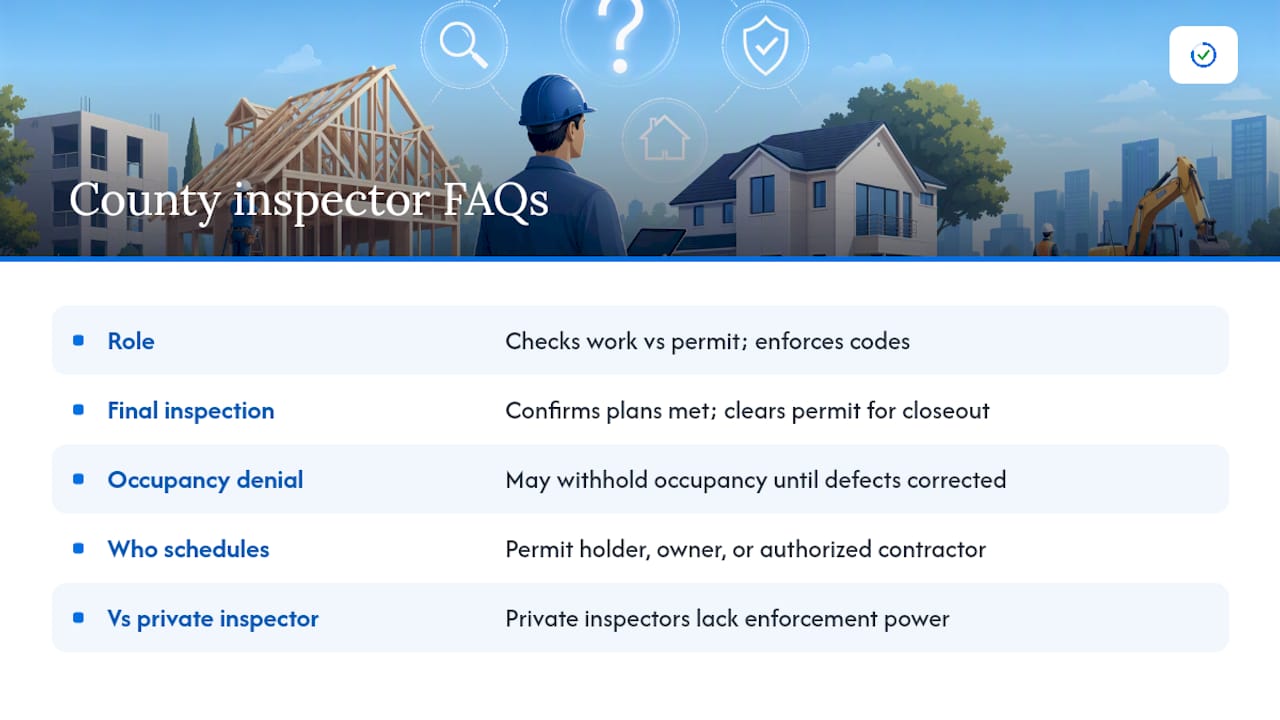
What’s the difference between a county inspector and a private home inspector? A county inspector enforces code compliance with legal authority; a private inspector evaluates a home’s condition for a buyer or seller and has no enforcement power.
Sources
- Construction and Building Inspectors : Occupational Outlook Handbook: : U.S. Bureau of Labor Statistics
- Homeowner | LADBS
- Permit guidance — Guilford County Inspections Department
- Field Inspector 2 — Pinellas County
Recommended
Is your permit package ready?
Run an AI readiness check against Miami-Dade requirements before you submit.
Start your first projectThis article is general guidance and not legal, engineering, or official county advice. Always verify requirements with Miami-Dade County before submitting a permit.