By the MiamiPermitAI team · August 19, 2026 · Updated September 30, 2026
What Is a Permit Readiness Review for Contractors?

A permit readiness review is a pre-submittal quality check on a construction permit package that catches missing documents, plan inconsistencies, and code conflicts before you file with the county. Instead of finding out about a problem from a municipal checksheet weeks later, you find out now. A typical review hands you:
- A readiness score showing how close your package is to submittal-ready
- A prioritized list of fixes, ranked by how likely each one is to trigger a rejection
- Flags for missing or incomplete documents a plan checker or code reviewer would otherwise catch
Key Takeaways
A permit readiness review works because it moves technical and administrative corrections earlier in the timeline, before a municipal checksheet ever gets issued.
| Point | Details |
|---|---|
| Definition | A readiness review is pre-submittal QC that catches document, coordination, and code issues before filing. |
| Biggest risk factor | Plan sets that contradict themselves across sheets cause most avoidable checksheets. |
| Best timing | Run the review after internal design coordination, but before formal municipal submission. |
| Cost logic | A review fee is small compared to the cost of one extra resubmission cycle and rework. |
| MiamiPermitAI’s role | Runs automated zoning, flood zone, and license checks against Miami-Dade data, backed by human QA, delivering a readiness score and fix list. |
Table of Contents
- What Does a Permit Readiness Review Cover?
- What Should Be on Your Permit Readiness Checklist?
- What Are the Most Common Reasons Permits Get Rejected?
- How Much Time and Money Does a Readiness Review Save?
- Who Should Order a Readiness Review, and When?
- How Does the Readiness Review Process Actually Work?
- What Does a Permit Readiness Review Typically Cost?
- Readiness Review vs. Completeness Review vs. Permit-Ready Letter
- How an AI-Powered Readiness Platform Works in Practice
- A Practical Note on What Actually Prevents Delays
- Get Your Miami-Dade Permit Checked Before You File
- Frequently Asked Questions
- Sources
What Does a Permit Readiness Review Cover?
A readiness review looks at document completeness, plan coordination across disciplines, code-check flags, zoning and site constraints, and administrative details like signatures and license numbers. It is not a rubber stamp. It is a structured pass through everything a municipal reviewer would touch, run before that reviewer ever sees the file.
Who runs one varies. Some owners hire third-party consultants who specialize in plan QA. Larger design firms run internal QA teams before releasing a set. Increasingly, AI platforms paired with licensed reviewers do the scan, catching pattern-based errors faster than a human alone would.
One distinction matters more than any other: a readiness review is not a municipal technical approval. It’s quality control you commission on your own timeline, aimed at making the actual permit review process shorter once you do file.
- Document completeness (forms, attachments, calculations)
- Plan coordination (do the sheets agree with each other)
- Code and zoning conflict flags
- Administrative fields and signatures
What Should Be on Your Permit Readiness Checklist?
Every discipline in your plan set has its own failure points, and a solid readiness checklist walks through each one separately rather than eyeballing the package as a whole.
Architectural sheets need internal agreement: sheet indices that match what’s actually included, keyed details that point to the right callouts, and dimensions and elevations that don’t contradict the floor plan. Structural sheets need framing details, a clear load path, foundation information, and soil reports with supporting calculations. Civil and site sheets need grading and drainage shown clearly, utility connections identified, and any easements or right-of-way constraints called out. Special disciplines, fire protection, accessibility, and MEP deferred submittals, often get missed entirely when a design team assumes “someone else is handling that sheet.”
| Category | What Gets Checked |
|---|---|
| Architectural | Sheet indices, keyed details, dimensions, elevations, sections |
| Structural | Framing, load paths, foundation data, soil reports, calculations |
| Civil/site | Grading, drainage, utility connections, easements, right-of-way |
| Special disciplines | Fire protection, accessibility, MEP deferred submittals |
| Administrative | Licenses, signed forms, complete application fields, attachments |
Pro Tip: Cross-check your civil sheet against your architectural site plan before submitting. Mismatched setback dimensions between the two are one of the fastest ways to draw a zoning comment.
What Are the Most Common Reasons Permits Get Rejected?
Municipal checksheets tend to repeat the same handful of complaints, and most of them are avoidable with a careful pre-submittal pass.
- Plan sets that disagree with themselves. One sheet shows a dimension or material the next sheet contradicts.
- Incomplete application forms, missing code analysis, or absent energy calculations.
- Zoning setback errors, lot coverage miscalculations, or missing FEMA flood documentation.
- Interdepartmental conflicts. Civil, utilities, and fire each sign off on different assumptions about the same site.
- Missing contractor licensing or bonding details, which can stall issuance even after the technical review clears, is why you should understand the requirements in the Road Opening Permit Victoria: A Contractor’s Compliance Guide.
Document format matters too. Cities publish specific submission rules, and failing to follow them, wrong file types, missing pages, incorrect scale, commonly delays review before a reviewer even reaches the technical content. None of these issues are exotic. They’re the same five or six problems, over and over, across projects of every size.
How Much Time and Money Does a Readiness Review Save?
The math is straightforward once you understand how municipal review cycles work. Most jurisdictions run an initial completeness check, then route the plan set to multiple technical reviewers who each issue a checksheet listing required corrections. Every resubmission restarts a portion of that cycle, and some departments escalate files that hit three rounds of comments to a supervisor for special handling.
Catching a coordination error before submittal means you never enter that loop for that item. It also means fewer recheck fees, since some departments charge per resubmission cycle.
There’s a financing angle too. Lenders often want documentation that a project is on track before releasing funds, and a clean readiness score gives contractors a stronger position when bidding or scheduling subcontractors around a predictable timeline.
The core insight: every avoided checksheet round is a cycle you don’t wait through, and repeated rounds are what stretch a six-week review into a three-month one.
Who Should Order a Readiness Review, and When?
Three groups get the most value: homeowners tackling major renovations or additions, licensed contractors preparing to bid or submit, and design professionals filing on behalf of clients. Each has a different stake in avoiding delays, but the timing advice is the same.
Run the review after your design is coordinated internally, but before you file with the county. That window catches cross-discipline conflicts your own team may not notice, without wasting the review on a set that’s still in flux.
- Homeowners: run it once contractor and architect drawings are finalized.
- Contractors: run it before committing to a bid schedule tied to permit issuance.
- Design teams: run it as the last internal QA step before release.
For complex or high-risk projects, a pre-application meeting with municipal staff earlier in design can surface zoning or infrastructure issues a readiness review alone won’t catch, since those questions often require a direct answer from the jurisdiction itself.
How Does the Readiness Review Process Actually Work?
A typical review moves through a consistent sequence, whether it’s run by a consultant or an AI-assisted platform working with licensed reviewers.
- Intake and completeness check against the required document list.
- A coordinated technical scan across the full plan set, checking sheets against each other.
- Discipline-specific checks (structural, civil, fire, accessibility, MEP).
- A compiled fix list, organized by discipline and severity.
- A final readiness score with a prioritized action plan for closing gaps.
Deliverables typically include an annotated plan set marking exactly where issues sit, a one-page executive summary for whoever’s managing the project, a fix list ticketed by discipline, and an estimated timeline for getting to resubmission-ready.
- Simple projects (a fence, a small addition) can get same-day triage tiers.
- Full plan sets on larger commercial or multi-discipline projects usually take several days.
- Most services offer an escalation option if a reviewer flags something needing a specialist’s eyes.
One pattern worth knowing: partial or inconsistent responses to a checksheet are the single most common cause of a second resubmission cycle. Fixing three of five flagged items and hoping the rest slide through rarely works.
What Does a Permit Readiness Review Typically Cost?
Pricing usually falls into three models: a flat fee for a full review, a lower tiered rate for quick triage on smaller projects, and subscription pricing for contractors running multiple permits per month.
Budget-wise, the comparison that matters isn’t the review fee against zero. It’s the review fee against the cost of one extra recheck cycle, resubmission fees, delayed subcontractor schedules, and in some cases a delayed closing or draw on financing. A review that costs a few hundred dollars but prevents even one avoidable resubmission round usually pays for itself.
- Flat-fee full reviews: best for one-off homeowner or small commercial projects.
- Tiered quick-triage pricing: best for simple scope, single-discipline projects.
- Subscriptions: best for contractors filing permits regularly.
Complexity drives price up fast. More disciplines, more sheets, and any required site investigation (soil reports, surveys) all add to review scope and cost.
Readiness Review vs. Completeness Review vs. Permit-Ready Letter
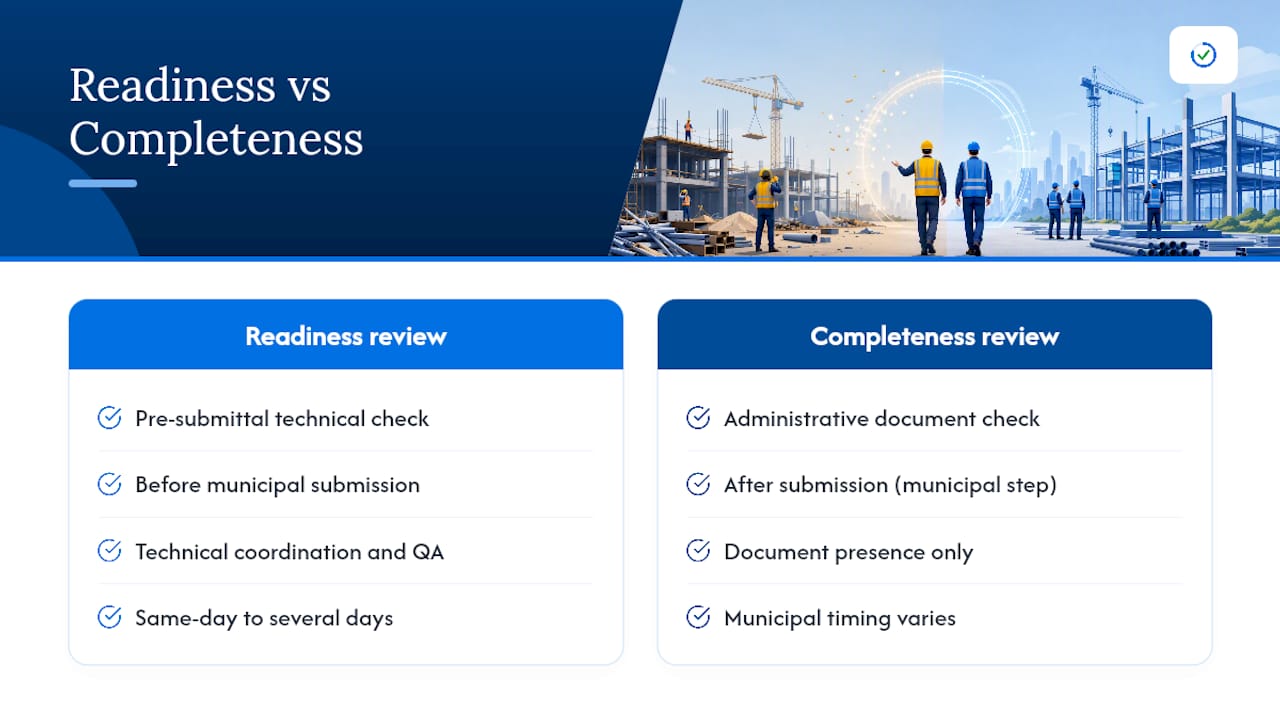
These three terms get used interchangeably, and they shouldn’t be. A municipal completeness review is an administrative check confirming required files are present before the technical review even starts. A permit-ready letter is an administrative confirmation issued after technical review is finished, meaning only fees or paperwork remain.
A permit readiness review sits before both of those. It’s a private, pre-submittal QC pass meant to harmonize your plan set and catch what would otherwise generate a completeness rejection or a technical checksheet in the first place.
- Completeness review: municipal, administrative, happens after you file.
- Permit-ready letter: municipal, administrative, happens near the end.
- Readiness review: private, technical and administrative, happens before you file.
How an AI-Powered Readiness Platform Works in Practice
Platforms like MiamiPermitAI illustrate how this process runs at speed. You upload your plan set, and the system checks it against Miami 21 zoning requirements, FEMA flood zone data, and Florida DBPR contractor license records, cross-referencing folio property records against what’s shown on your site plan. A human QA layer reviews flagged items before anything reaches you.
Outputs mirror what a manual reviewer would produce: a readiness score, annotated sections of your plan set showing exactly where a conflict sits, and a one-page executive summary you can hand to a contractor or client without walking them through raw markup.
- Automated zoning, flood zone, and license checks run first
- A human reviewer validates flagged items before you see the report
- You get a scored, prioritized fix list instead of a wall of notes
Pro Tip: For complex or unusual projects, pair an AI readiness review with a preliminary pre-application meeting with the county. The review catches document and coordination issues; the meeting resolves judgment calls only a reviewer can answer.
A Practical Note on What Actually Prevents Delays
Permit delays rarely come from complicated design decisions. They come from a dimension that doesn’t match between two sheets, or a form field left blank because nobody owned that task. Pre-submittal QA catches the boring stuff, and the boring stuff is what stalls permits.
Get Your Miami-Dade Permit Checked Before You File
MiamiPermitAI gets you the same pre-submittal clarity described throughout this guide, built specifically around Miami-Dade’s zoning maps, flood zone data, and contractor license records, so the flags you get back are grounded in your actual jurisdiction, not generic code language.
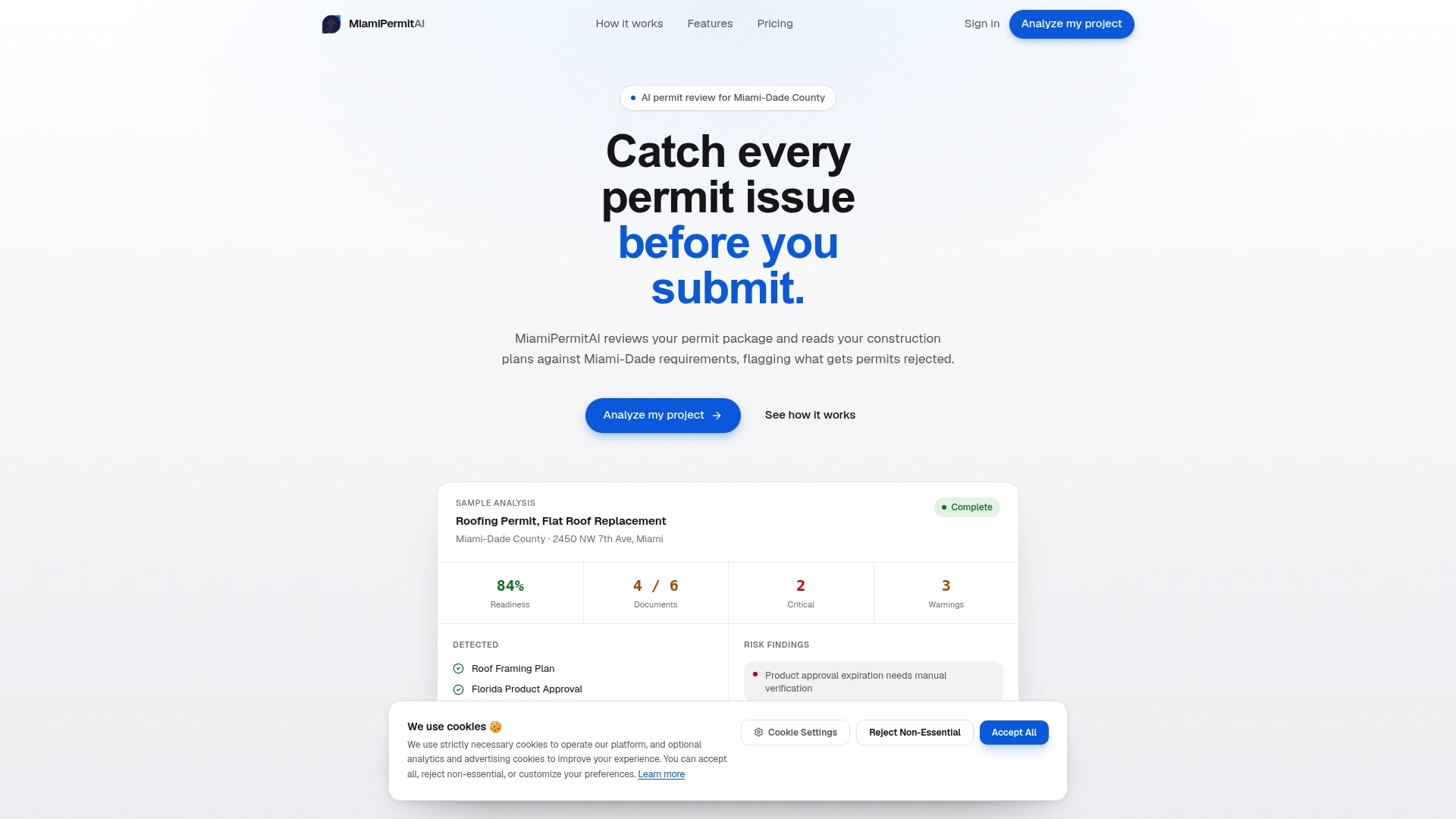
You can run a one-time analysis on a single permit package, or subscribe if you’re a contractor filing multiple permits a month. Either way you get a readiness score, an annotated plan set, and a prioritized fix list before you ever submit to the county. Homeowners with a single addition or renovation typically do best with a one-time review; contractors juggling multiple active jobs get more value from the subscription tier. Start by uploading your plan set at the MiamiPermitAI landing page and see your readiness score before you file.
Frequently Asked Questions
What is a permit readiness review, in one sentence? It’s a pre-submittal check on your plan set and documents that flags the errors most likely to trigger a municipal rejection or checksheet.
Is a permit readiness review the same as a completeness review? No. A completeness review is a municipal administrative step confirming your file has the right documents; a readiness review happens beforehand and covers technical coordination too.
How long does a readiness review take? Simple projects can get same-day triage; full multi-discipline plan sets usually take several days depending on scope.
Does a readiness review guarantee permit approval? No review can guarantee approval, since final technical judgment rests with the municipal reviewer, but it substantially reduces avoidable comments and resubmission cycles.
Who should order one first, the contractor or the design team? Whoever is closest to finalizing the plan set should order it, typically the design team as their last internal QA step, or the contractor if they’re managing the submission.
Sources
- Construction permit timeline | Seattle Department of Construction & Inspections
- Portland
- Building permit | City of San Diego Official Website
Recommended
Is your permit package ready?
Run an AI readiness check against Miami-Dade requirements before you submit.
Start your first projectThis article is general guidance and not legal, engineering, or official county advice. Always verify requirements with Miami-Dade County before submitting a permit.