By the MiamiPermitAI team · August 26, 2026 · Updated September 30, 2026
Do You Need a Driveway Permit in Miami-Dade County?
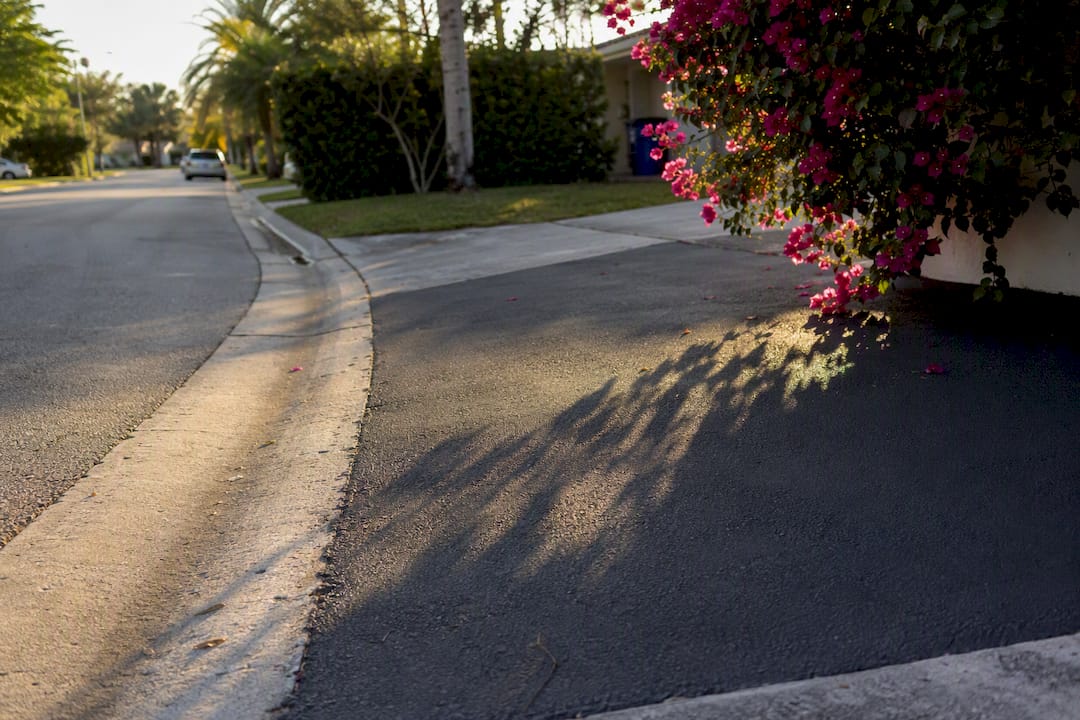
Yes. Almost any new driveway, widened apron, or resurfaced approach in Miami-Dade County needs a county permit before a contractor breaks ground. Start now, not after the concrete truck is booked: pull together a current site survey, dated site photos, and exact measurements of the proposed driveway, then check two things immediately, whether an HOA has to sign off and whether an active septic tank sits on the property.
Most residential applications go through Miami-Dade’s Public Works permit application, but if your driveway touches a county-maintained road, the Department of Transportation and Public Works (DTPW) has exclusive say over that stretch. Before you draw a single line on a plan, run it past a tool like MiamiPermitAI, which checks your package against Miami-Dade’s own requirements and flags problems before a reviewer does.
- Gather: site survey, current photos, measurements, HOA status, septic status
- Confirm jurisdiction: standard building permit or DTPW right-of-way permit
- Submit through the county permits portal or the correct office in person
Quick fact: Miami-Dade code sets driveway width minimums at appropriate widths for two-way and one-way traffic, and it flatly prohibits driveways that block sidewalks or rights-of-way, per county driveway rules.
Key Takeaways
Most Miami-Dade driveway permits fail on paperwork consistency and sight-distance design, not on the driveway itself, so fixing those two areas before submission is the single highest-leverage move.
| Point | Details |
|---|---|
| Confirm jurisdiction early | Check whether DTPW controls the right-of-way before submitting to a standard building office. |
| Complete the document set | Survey, photos, measurements, HOA letter, and Water & Sewage bill must all match. |
| Check sight distance on-site | Stand at the proposed curb cut and verify visibility before finalizing plans. |
| Budget for a corrections cycle | Incomplete submittals almost always add a review round before approval. |
| Consider a readiness check | Non-standard materials, septic systems, and corner lots benefit most from a pre-submission review. |
Table of Contents
- What Documents Do You Need for a Miami-Dade Driveway Permit?
- Where Do You Submit a Driveway Permit Application in Miami-Dade?
- Why Do Driveway Permits Get Rejected in Miami-Dade?
- How Long Does Driveway Permit Approval Take in Miami-Dade?
- How Do You Apply for a Driveway Permit Step by Step?
- Can a Permit-Readiness Review Actually Save You Time?
- What Should You Prioritize First With a Driveway Permit?
- Sources
What Documents Do You Need for a Miami-Dade Driveway Permit?
Reviewers reject more applications for missing paperwork than for bad design. Here’s exactly what to have in hand before you submit.
- Site survey. A current, professional survey showing property lines, existing structures, and the proposed driveway location. An outdated survey, or one missing a dimension a reviewer needs, is one of the fastest ways to trigger a correction letter.
- Current site photos. Reviewers want to see the property as it exists today, not as it appeared on an old permit file. Take wide shots of the frontage, the curb, and anything near the proposed approach.
- Detailed measurements of the proposed driveway. Width, length, setback from the property line, and flare-out dimensions where the driveway meets the street. Vague notations like “approximately 20 feet” invite a rejection.
- Material specifications. Plain concrete or asphalt is standard. Brick pavers or stamped concrete require a recorded Construction Covenant, which the county files against the property.
- Water & Sewage bill. This confirms whether the home is on county sewer or an active septic system, a detail that changes what else you need to submit.
- HOA approval, when applicable. The county’s own Public Works permit application states plainly that a county permit does not replace HOA sign-off. Skipping this step doesn’t just risk a permit delay, it can mean a neighborhood association fine after the work is done.
- Sealed plans, when the scope requires a licensed design professional’s stamp, typically for larger commercial approaches or unusual grading.
If an active septic tank shows up on that Water & Sewage bill, your driveway sketch needs a Health Department stamp before the county will move the file forward. Skip that step and expect the application to sit untouched until it’s added.
Pro Tip: Photograph your existing driveway and the surrounding curb from at least three angles, wide, straight-on, and from each side, so a reviewer never has to guess at a dimension you could have shown them.
Where Do You Submit a Driveway Permit Application in Miami-Dade?
Sending the right paperwork to the wrong office is its own kind of rejection. Miami-Dade splits driveway permitting by project type and location, and getting this wrong costs you a resubmission cycle you didn’t need.
- Downtown office generally handles residential driveway updates and standard homeowner applications.
- West Dade office typically processes commercial approaches, new construction, and driveways tied to properties still under active construction, according to the county’s construction and permitting procedures page.
- DTPW holds exclusive jurisdiction over any driveway work that touches a county-maintained right-of-way, under Ordinance No. 21-99. If your curb cut affects the public road edge, this is a separate track from a standard building permit.
- Not sure which one applies? Email DTPW directly at dtpwpermits@miamidade.gov before you submit anything, rather than finding out three weeks later that your file landed in the wrong queue.
- Special documents, like a recorded Construction Covenant, sometimes need in-person drop-off rather than an online upload; the county’s driveway subcategory page lists current drop-off details.
Why Do Driveway Permits Get Rejected in Miami-Dade?
Four issues account for most of the corrections letters homeowners and contractors receive, and every one of them is fixable before you ever submit.
Sight-distance triangle violations. Miami-Dade’s code enforces a safe sight-distance requirement at every driveway entry, and corner-lot properties trip this rule constantly. Before your designer finalizes a curb cut, stand at the proposed driveway location and check whether a car pulling out can actually see oncoming traffic in both directions. If a fence, hedge, or parked vehicle blocks that view on paper, a reviewer will catch it.
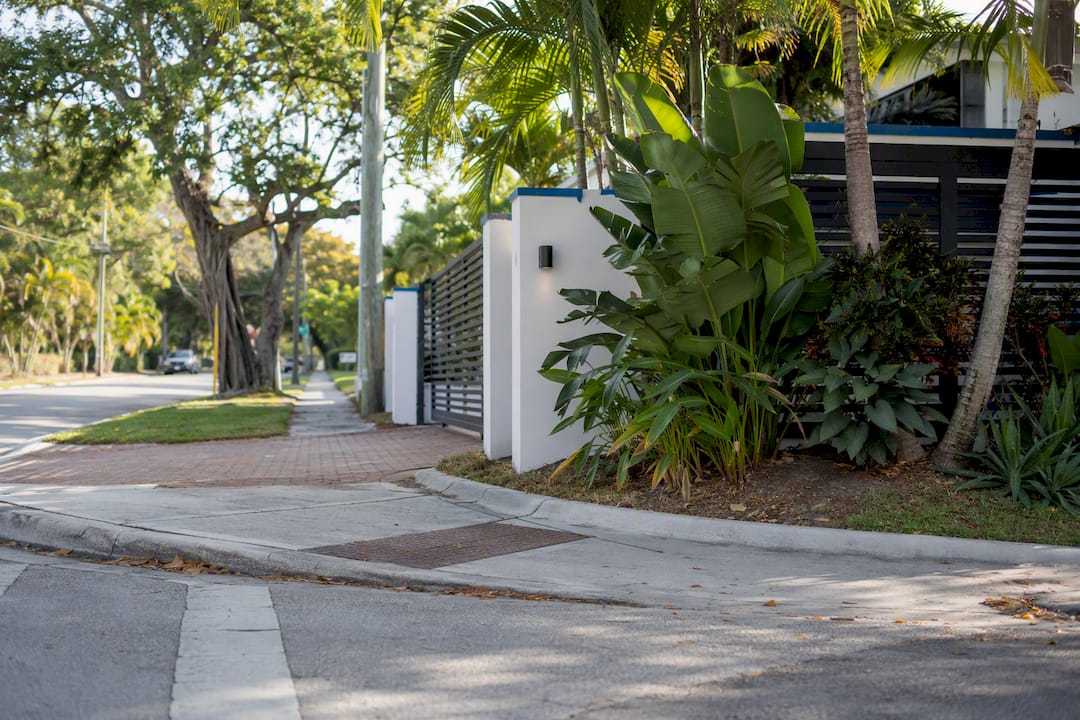
Document gaps. A survey that’s too old, a missing HOA letter, an absent Water & Sewage bill, or measurements that don’t match between the survey and the application form. Reviewers cross-check every number, so a driveway listed as 18 feet on one page and 20 feet on another gets flagged automatically.
Contractor licensing problems. Florida requires an active DBPR license and proof of insurance for the contractor of record. An expired license number on the permit application is an instant hold.
Missing Construction Covenant. Brick pavers and stamped concrete need that covenant recorded before approval, not after. Practitioners consistently point to the sight-distance triangle as the single most common design-level rejection, ahead of paperwork issues.
How Long Does Driveway Permit Approval Take in Miami-Dade?
Expect three phases: initial review, a corrections cycle if anything’s missing or inconsistent, and final approval. A clean, complete package moves faster through the first pass; a package with a vague survey or absent HOA letter almost always bounces back for at least one round of corrections. Projects that involve DTPW review, flood-elevation checks, or septic verification tend to run longer, since those add an extra department to the sign-off chain.
Fees typically fall into a few buckets:
- A plan review fee, charged when the application is first logged
- A permit fee, tied to the scope and value of the work
- Possible public works or right-of-way fees if DTPW is involved
Fee amounts change periodically, so verify current numbers directly through the county’s permits portal rather than relying on an old estimate. Once approved, the county schedules a driveway inspection to confirm the built work matches the approved plan. Keep copies of any recorded Construction Covenant or Health Department stamp; you’ll want them on hand if a question comes up mid-inspection.
How Do You Apply for a Driveway Permit Step by Step?
- Build the complete package first. Use the documents checklist above: survey, photos, measurements, material specs, HOA letter, Water & Sewage bill, and sealed plans if the scope calls for them.
- Pick the right permit category and office. Confirm whether you’re filing a standard residential application, a commercial one through West Dade, or a DTPW right-of-way permit, then submit online or drop off in person with every attachment included.
- Read the corrections letter carefully if one arrives. Reviewers usually cite the exact code section or missing document. Fix that specific issue, don’t guess at a broader redesign, and resubmit.
- Schedule inspections after approval. Once the permit issues, request the driveway inspection through the county’s process and keep your recorded Construction Covenant or Health Department stamp on file.
- Track status through Miami-Dade’s public permit records so you know exactly where the file sits without calling the office every few days.
Pro Tip: When you get a corrections letter, respond to every line item in the order the reviewer listed them. Reviewers process resubmittals faster when the fixes map directly to their original notes.
Can a Permit-Readiness Review Actually Save You Time?
A second set of eyes before you submit catches the kind of mistakes that turn a two-week approval into a two-month ordeal. MiamiPermitAI reviews your package against Miami 21 zoning, FEMA flood-zone data, folio property records, and Florida DBPR license status, then hands back a readiness score and a specific fix list before the county ever sees your file.
- Non-standard materials like pavers, where a missing Construction Covenant is an easy miss
- Corner lots, where sight-distance triangle math genuinely gets complicated
- Properties with an active septic system, where a Health Department stamp is easy to overlook
- Any driveway that might touch a county right-of-way, where DTPW jurisdiction adds a step most homeowners don’t expect
A readiness review doesn’t replace the county’s review, it front-loads the corrections you’d otherwise get three weeks after submitting.
Pro Tip: Run a readiness check before your survey is even finalized, so you know which measurements matter most before you pay for a revision.
| What you get | Why it matters |
|---|---|
| Readiness score | Tells you how close your package is to a clean county approval |
| Priority fix list | Points to the exact document or plan issue reviewers flag most |
| Zoning and flood checks | Confirms Miami 21 setbacks and FEMA flood-zone requirements before submission |
| Post-submission tracking | Follows your permit through public records so you’re not guessing at status |
For a related permit checklist in a different Florida project category, see this screen enclosure permit guide, which walks through similar document-prep logic homeowners can apply here.
If your driveway is anything other than a straight concrete slab on a standard rectangular lot, run it through MiamiPermitAI before you file. The platform’s readiness check catches the same issues a county reviewer would, just before the clock starts on your submission instead of after.
What Should You Prioritize First With a Driveway Permit?
The conventional advice on driveway permits treats every application like a formality, fill out a form, wait a few weeks, done. That’s not what the county’s own forms suggest. The Public Works application itself warns that a permit doesn’t erase your HOA obligations, which tells you the county has seen enough disputes to build the warning directly into the paperwork.
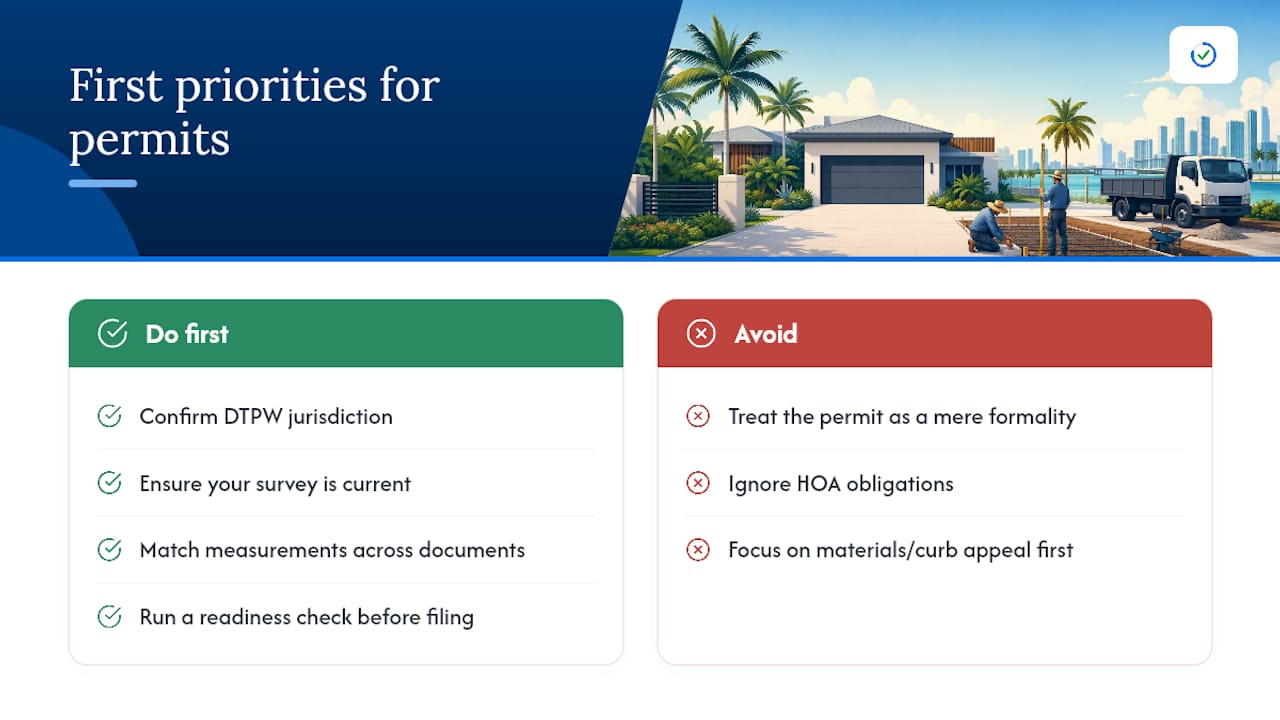
What actually separates a smooth approval from a frustrating one isn’t the driveway design, it’s the boring stuff: whether your survey is current, whether your measurements match across every document, and whether you checked jurisdiction before you submitted. Homeowners fixate on material choice and curb appeal. Reviewers fixate on sight lines and paperwork consistency.
My honest read: if your project involves anything beyond plain concrete on a straight lot, spend the extra hour confirming DTPW jurisdiction and running your plans past a readiness check before you file. The cost of a wrong guess isn’t the fee, it’s the four weeks you lose to a correction cycle you could have avoided.
Sources
- Public Works permit application (Miami‑Dade)
- Miami‑Dade permits: driveways (all-permits page)
- Miami‑Dade County Code (Municode) — driveways/sight distance
- DTPW permits (Miami‑Dade Transportation & Public Works)
Recommended
Is your permit package ready?
Run an AI readiness check against Miami-Dade requirements before you submit.
Start your first projectThis article is general guidance and not legal, engineering, or official county advice. Always verify requirements with Miami-Dade County before submitting a permit.