By the MiamiPermitAI team · August 23, 2026
How Long Does It Really Take to Get a Permit in Miami-Dade?
Most Miami-Dade building permits that don’t trigger a special review land somewhere between two and twelve weeks from submission to issuance. Minor work like a water heater swap or a fence often clears in under two weeks. A standard residential alteration typically runs four to eight weeks. Add a Historic Preservation Board hearing, a DERM environmental review, or a coastal construction control line review, and that window stretches to months, not weeks.
The single biggest variable isn’t the county’s workload; it’s whether your application is complete on day one and whether it needs a review outside the standard building-code track.
- Minor permits (electrical swap, water heater, small repairs): often within a couple of weeks
- Standard alterations and additions: roughly 4 to 8 weeks
- New construction and multifamily: several months, sometimes longer with site work
- Anything touching DERM, Fire, or the Historic Preservation Board: add weeks to months
Florida Statute 553.792 sets statutory review windows for many permit types, ranging from 10 to 60 business days depending on the project, once your application is deemed complete. Miami-Dade’s own plan review guidance puts many initial reviews at 24 hours to 10 business days. You can track exactly where your file sits using your process number in the county’s online status portal.
Key Takeaways
Permit timelines in Miami-Dade depend far less on county workload than on application completeness and whether special reviews like DERM or HPB get triggered.
| Point | Details |
|---|---|
| Timeline varies by project type | Minor permits often clear in 1 to 2 weeks; new construction can take several months. |
| Statute sets minimum accountability | Florida Statute 553.792 requires action within 10 to 60 business days for qualifying, complete applications. |
| Special reviews are the real risk | DERM, HPB, and coastal reviews sit outside the statutory clock and can add weeks to months. |
| Completeness beats speed requests | Sealed plans, valid NOAs, and correct flood data prevent the resubmittal cycles that cause most delays. |
| Track status actively | Use your process number in the county portal and respond to comments within the applicant window. |
Table of Contents
- Permit Timeline Expectations in Miami-Dade by Project Type
- What Happens During Each Stage of Plan Review
- What Florida Statute 553.792 Actually Guarantees You
- Why Permits Get Delayed and How to Avoid It
- How MiamiPermitAI Helps You Avoid the Resubmittal Cycle
- What the Timelines Actually Tell You
- Frequently Asked Questions
- Sources
Permit Timeline Expectations in Miami-Dade by Project Type
The permit timeline expectations Miami-Dade contractors and homeowners plan around depend almost entirely on which review track a project falls into. A shed permit and a five-story addition are not moving through the same queue, and treating them as if they were is how people end up blindsided.
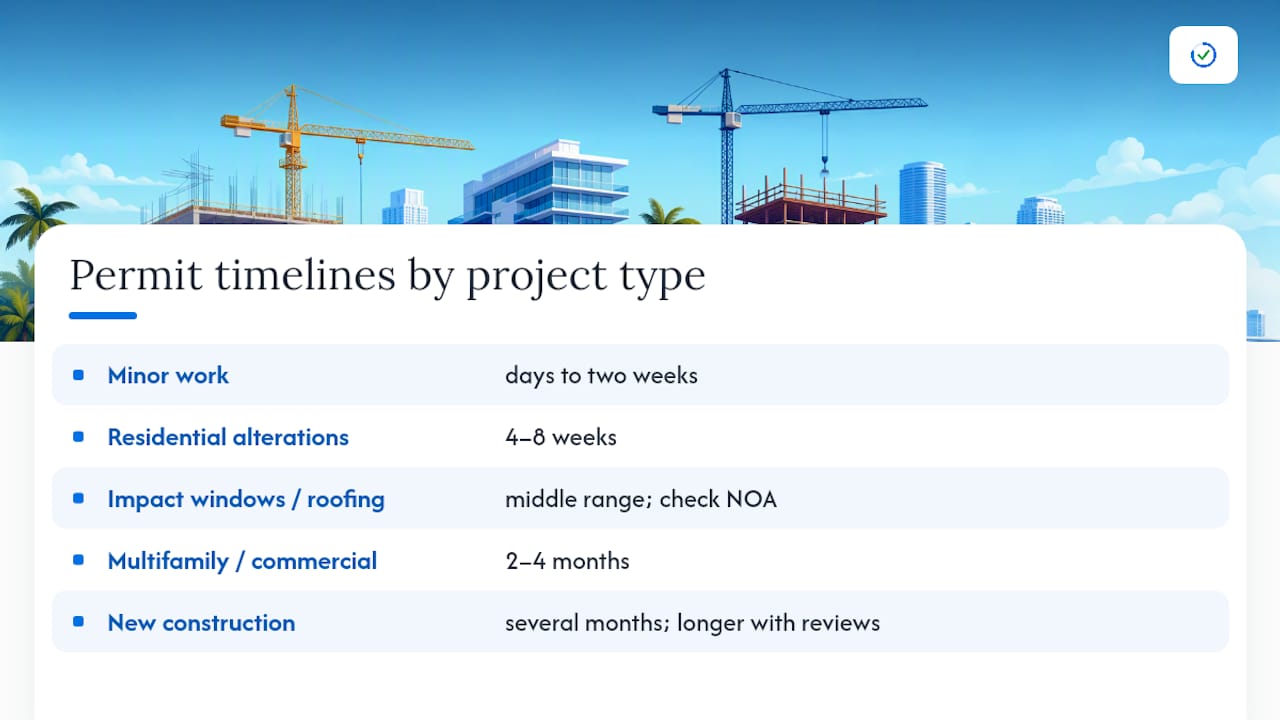
Minor work and sub-permits (electrical, mechanical, plumbing trade permits, small repairs, water heaters, some fences) usually move fastest. These often skip full structural review and can clear in a matter of days to two weeks when the paperwork is clean.
Standard residential alterations (kitchen remodels, bathroom additions, interior renovations that don’t touch the building envelope) typically take four to eight weeks. These pull in more disciplines: electrical, mechanical, plumbing, sometimes structural if you’re moving a wall.
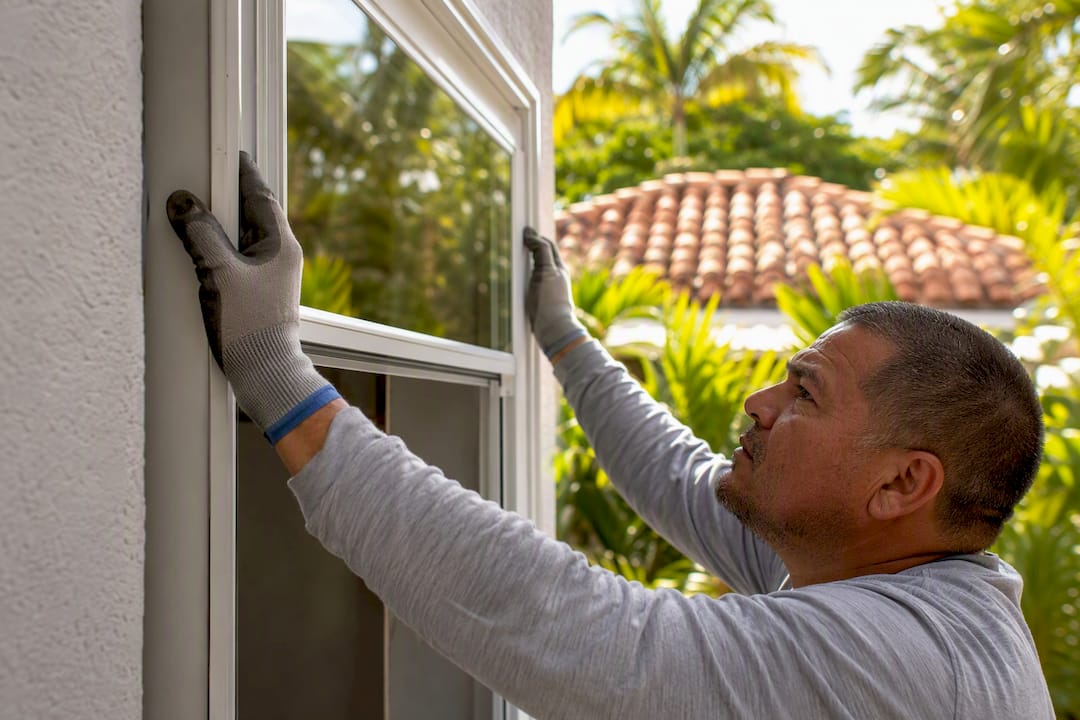
Impact windows and roofing permits sit in a strange middle zone. The application itself is often simple, but Miami-Dade’s High-Velocity Hurricane Zone rules mean every window, door, and roofing product needs a valid Notice of Acceptance (NOA) on file. Missing or expired NOAs are one of the most common reasons these permits stall, which is worth checking against the county’s NOA product approval requirements before you submit.
Multifamily and commercial projects routinely run longer, often two to four months minimum, because they trigger more disciplines simultaneously: structural, fire, accessibility, and sometimes traffic or utility coordination.
New construction is the longest track by default. Full site plans, structural calculations, impact fees, and often DERM or zoning review stack on top of standard plan review. A single-family new build in a straightforward lot might take several months. A new build near a shoreline, in a flood zone requiring elevation certificates, or on a historic-district lot can take even longer.
Public permit-data analysis backs up the wide spread here. One open-data review of Miami permit records reported a median approval time around 27 days, with the 75th percentile stretching to roughly 49 days, and longer tails for coastal or historically designated properties. Medians are useful for planning, but the tail is where projects actually blow their schedules. Special reviews are the reason: DERM environmental reviews alone can add 4 to 16 weeks, and coastal construction control line reviews can add two to four months on top of standard plan review.
What Happens During Each Stage of Plan Review
A permit application doesn’t sit in one queue from start to finish. It moves through distinct stages, and understanding where the clock actually starts (and stalls) helps you plan realistically.
- Intake. Your application is logged and assigned a process number, but the review clock generally doesn’t start until required upfront fees are paid and the submittal package is complete. An “accepted” status doesn’t always mean “in review.”
- Plan review. Reviewers from each required discipline (structural, electrical, mechanical, plumbing, zoning, and others depending on scope) check your plans against code. Miami-Dade’s guidance on plan review timelines puts many initial reviews at 24 hours to 10 business days per discipline, though complex projects with multiple reviewers can take longer simply from queuing.
- Comments and resubmittal. If a reviewer finds an issue, you get a corrections letter. How fast and how thoroughly you respond directly affects your total timeline, and sloppy resubmittals often trigger a second, third, or fourth review cycle. Understanding what reviewers actually check before you resubmit cuts down on repeat rejections.
- Special reviews. Projects touching wetlands, waterways, coastal zones, or landmark-designated properties get routed to DERM, the Historic Preservation Board, or similar bodies. These run on their own schedules, sometimes tied to monthly meeting cadences, and they queue separately from standard plan review.
- Final approval and issuance. Once every discipline signs off, the permit issues. Any outstanding fees typically need to clear before you get the physical permit.
Pro Tip: The fastest way to lose weeks isn’t a slow reviewer. It’s a resubmittal that only fixes half the comments, forcing another full review cycle instead of a quick sign-off.
What Florida Statute 553.792 Actually Guarantees You
Florida Statute 553.792 doesn’t promise your permit gets approved fast. It promises the jurisdiction has to act, one way or another, within a defined window once your application is complete.
- 10 business days applies in some CDBG-DR-related cases.
- 12 business days covers master permit applications.
- 30 business days covers most structures under 7,500 square feet.
- 60 business days covers larger structures and most non-residential projects.
These windows only start once the county considers your application complete, and they only cover disciplines governed by the Florida Building Code. DERM, Fire Rescue, zoning appeals, and Historic Preservation Board reviews sit outside the statute’s clock, which is exactly why those reviews are the ones that blow up an otherwise on-track timeline.
The statute also puts obligations on you, the applicant. When the jurisdiction issues corrections, you generally have your own response window, commonly referenced as a 10-business-day correction period, to keep the statutory clock running in your favor. Miss it, and you risk falling outside the protections the law provides.
Florida Statute 553.792 also includes a provision that applicants may receive a reduction in permit fees if the jurisdiction fails to meet its statutory review deadline. It’s a real consequence for the county, not just a guideline on paper.
Jurisdictions can offer applicants a waiver of these statutory timelines in exchange for other considerations, such as priority in an expedited program. That trade-off is worth understanding before you sign one away.
Why Permits Get Delayed and How to Avoid It
Almost every serious delay traces back to one of a handful of preventable problems, and most of them are fixable before you ever hit submit.
- Missing or unsealed structural, electrical, or mechanical plans (Miami-Dade requires digitally sealed documents for e-submittal)
- Expired or missing Notices of Acceptance for windows, doors, and roofing products
- Incorrect flood elevation data, especially on properties near updated FEMA flood zone maps
- Missing or mismatched licensed contractor information
- Filing with the wrong jurisdiction (county versus incorporated city) for a given folio
That last one deserves its own callout. Folios starting with “30” generally fall under unincorporated Miami-Dade County jurisdiction, while properties inside incorporated cities like Miami, Coral Gables, or Hialeah file with the city instead. Filing with the wrong authority means starting over with the correct one, which erases weeks of progress instantly.
Paying all required fees upfront and attaching properly sealed digital plans on the first submittal starts the review clock sooner and avoids the frustrating “accepted but not in review” limbo that eats time without anyone doing anything wrong. Reviewing a complete documents checklist by permit type before you submit, and following resubmittal best practices when comments come back, are the two highest-leverage habits available to you.
Pro Tip: The first round of plan-review comments, usually landing somewhere between day 30 and day 75 of the process, is your highest-leverage moment. A fast, complete response here often determines whether your project finishes on schedule or drifts into a second and third review cycle.
How to Check Your Permit Status Without Guessing
- Locate your process number, issued at intake, and enter it into Miami-Dade’s online plan status portal.
- Read the status label carefully: “accepted” means logged, not necessarily under active review; “in review” means a discipline currently has your plans; “comments issued” means it’s your move now.
- If your status shows “rework submitted,” that means your resubmittal is back in the queue, generally following the same review windows as the original submittal, per the county’s plan review guidance.
- “Approved, pending fees” means the technical review is done. Pay outstanding fees promptly to get your physical permit issued.
Expedited Review Programs Worth Knowing About
Miami-Dade offers several tracks that can shorten the standard timeline, though eligibility and availability shift over time. These include an affordable and workforce housing expedited review, a concierge plan review service, a cookie-cutter program for repeated building models, a green building expedited track, and a master model program for builders using the same plans across multiple lots.
Most of these come with trade-offs: eligibility restrictions, added fees, or limits on how many concurrent reviews you can run. If your project fits a repeatable model or qualifies under an affordable housing designation, it’s worth asking the county directly about current program availability rather than assuming standard timelines apply.
How MiamiPermitAI Helps You Avoid the Resubmittal Cycle
Most permit delays aren’t caused by an overloaded reviewer. They’re caused by a package that gets rejected on the first pass and has to go through the queue again. MiamiPermitAI checks your permit package and uploaded plans against Miami-Dade requirements before you ever submit, cross-referencing Miami 21 zoning rules, FEMA flood zone data, folio property records, and Florida DBPR contractor license verification.
- A readiness score that flags whether your package is likely to pass or bounce
- A plain-language fix list covering missing documents and plan inconsistencies
- Post-submission tracking that pulls from public Miami-Dade records and emails you status changes automatically
Catching a missing NOA or an unsealed structural sheet before submission means skipping an entire review cycle, not waiting weeks to find out it was wrong.
Pro Tip: Run your package through a readiness check before intake, not after your first corrections letter arrives. It’s the difference between fixing a problem once and fixing it twice.
Checking your plans against Miami-Dade’s actual requirements before submission is the most direct way to protect the timeline you’re planning around.
What the Timelines Actually Tell You
Most advice about permit timelines treats the statutory windows in Florida Statute 553.792 like a guarantee. They’re not. They’re a floor on how long a jurisdiction can sit on a complete application, not a ceiling on your total project timeline, and conflating the two is where homeowners get blindsided by a DERM review that adds four months nobody warned them about.
The conventional advice, “submit early and be patient,” misses the actual leverage point. The real window that determines your outcome is the first round of comments. Projects that respond fast and completely at that stage rarely see a third review cycle. Projects that trickle in partial fixes almost always do.
If you take one thing from this, prioritize completeness over speed at submission. A perfect package submitted on time beats a rushed one that bounces twice. Build your schedule around the median, but plan your contingency around the tail, because that’s where DERM, HPB, and coastal reviews actually live.
Frequently Asked Questions
How long does a standard building permit take in Miami-Dade? Most standard residential alterations take four to eight weeks from a complete submission to issuance, assuming no special reviews are triggered.
Does Florida Statute 553.792 guarantee my permit gets approved by a certain date? No. It requires the jurisdiction to approve, conditionally approve, or deny a complete application within a set window (10 to 60 business days depending on the permit), but it doesn’t cover DERM, Fire, or Historic Preservation Board reviews.
Why is my permit stuck even though it says “accepted”? “Accepted” often means your file was logged, not that review has started. Review generally begins once upfront fees are paid and the submittal is complete.
What’s the fastest way to check my Miami-Dade permit status? Use your process number in Miami-Dade’s online plan status portal, which shows exactly which discipline currently holds your file.
Can I speed up my permit with an expedited review program? Possibly. Miami-Dade offers several expedited tracks, including cookie-cutter and concierge review programs, though eligibility and fees vary by program and project type.
Sources
- Plan Review - Miami-Dade County
- Miami Building Permit Timeline — How Long Does a Permit Take? - Prevesta
Recommended
Is your permit package ready?
Run an AI readiness check against Miami-Dade requirements before you submit.
Start your first projectThis article is general guidance and not legal, engineering, or official county advice. Always verify requirements with Miami-Dade County before submitting a permit.