By the MiamiPermitAI team · August 25, 2026 · Updated September 30, 2026
Do Deck Permits Really Matter When You Sell Your Home?
Yes. A permitted deck protects your resale value; an unpermitted one usually costs you money, time, or both. Appraisers can refuse to credit a deck without permit records, lenders can flag it, and buyer’s agents typically push for a 10 to 20 percent discount on the affected value once the issue surfaces. That gap is bigger than most sellers expect from a structure that looks perfectly fine.
Before you list, do this:
- Pull your property’s permit history and confirm a final inspection sign-off exists.
- Gather the original permit PDF, inspection reports, and any certificate of completion.
- If nothing shows up, talk to a licensed contractor before a buyer’s inspector does.
Key Takeaways
Permitted decks protect appraised value and buyer confidence, while unpermitted ones routinely cost sellers a 10 to 20 percent negotiation discount or worse.
| Point | Details |
|---|---|
| Check permit records first | Search your county database by address before listing to know exactly what you’re dealing with. |
| Negotiation risk is real | Buyers and agents typically seek a 10 to 20 percent discount on unpermitted improvements. |
| Inspections target hidden risk | Ledger connections and footings cause most deck failures, which is why staged inspections exist. |
| Fixing it usually beats crediting it | Retroactive permit costs are often lower than the buyer credit you’d otherwise give at closing. |
| Use a readiness check early | MiamiPermitAI reviews your permit package against Miami-Dade requirements before you submit, flagging fixes ahead of time. |
Table of Contents
- Why Deck Permits Matter for Home Resale: Appraisals, Financing, and Buyer Confidence
- What Do Deck Permit Inspections Actually Check?
- What Happens to Sellers Who Skip the Permit Process?
- How Do You Check Permit Status Before Listing?
- Retroactive Permits, Repairs, or Removal: Choosing the Right Fix
- A 30 to 90 Day Timeline for Fixing Permit Gaps Before You List
- Does an Unpermitted Deck Affect Your Homeowners Insurance?
- Will a Deck Permit Raise Your Property Tax Assessment?
- Why It Pays to Resolve Permit Gaps Before You List
- How MiamiPermitAI Helps You Close Permit Gaps Before You List
- Sources
Why Deck Permits Matter for Home Resale: Appraisals, Financing, and Buyer Confidence
Appraisers work from documentation, not curb appeal. If a deck has no permit on file, an appraiser can simply exclude it from the home’s value, treating a $12,000 structure as if it doesn’t exist on paper. That hits your appraised value directly, and it hits your buyer’s loan approval right behind it.
FHA and VA loans tend to scrutinize permit history more closely than conventional financing, and plenty of conventional lenders now ask for permit records as a standard condition before closing. A missing file can stall underwriting for weeks while everyone scrambles to figure out what actually got built and whether it’s safe.
Buyers use uncertainty as leverage. When a permit search comes back empty, agents typically negotiate a 10 to 20 percent discount on the affected improvement’s value, according to EffectiveAgents. On a deck that added $10,000 in perceived value, that’s $1,000 to $2,000 gone before you even get to inspection repairs.
A few other ways this plays out at the negotiating table:
- Buyers ask for a credit instead of trusting a seller’s word that “it’s fine.”
- Title and closing agents sometimes flag the issue independently, which slows everyone down.
- Homeowners insurance underwriters occasionally ask about permit status on larger structures, adding another layer of buyer caution.
What Do Deck Permit Inspections Actually Check?
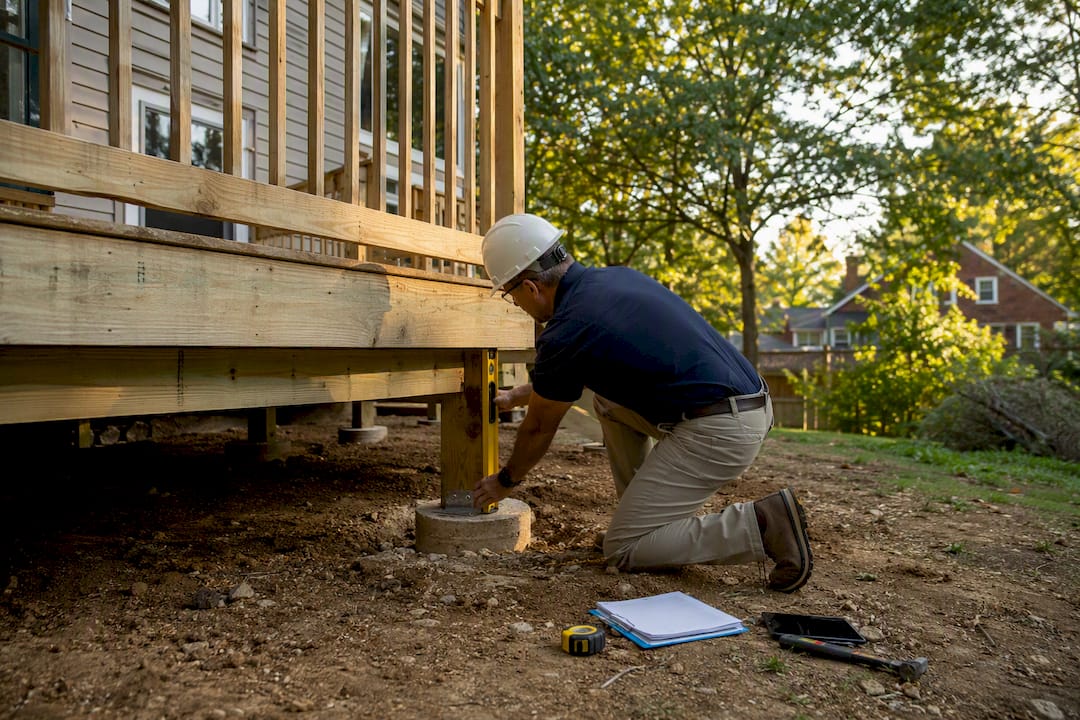
A permit isn’t a piece of paper. It’s a record that someone with training looked at the parts of your deck you can’t see once the boards go down. Ledger connections and footings are the most common failure points in deck collapses, which is exactly why inspectors focus there first.
A typical inspection sequence checks:
- Ledger board attachment to the house framing (not just to siding or stucco).
- Footing depth and placement, since undersized footings shift over time.
- Post connections and bracing.
- Railing height and baluster spacing, which matter for fall prevention.
- Lateral load anchors that keep the deck from pulling away from the house during heavy use.
A deck can look flawless and still fail every one of those points. Fresh stain hides a bolted ledger just as easily as it hides a properly lagged one.
Pro Tip: Staged inspections (footing, framing, final) exist because each stage covers something the next one buries. Skipping the footing inspection means nobody ever verifies what’s holding the whole structure up.
What Happens to Sellers Who Skip the Permit Process?
The friction usually follows a predictable path: a buyer’s inspector notices a deck that looks recently built, asks about the permit, and the listing agent goes searching for a record that doesn’t exist. From there, the lender’s underwriter and the appraiser start asking their own questions, and your closing timeline slips.
Enforcement outcomes vary by jurisdiction, but the range includes:
- A stop-work order or code violation notice, especially if a neighbor or inspector flags the structure independently.
- A retroactive permit requirement, which can mean opening up framing that’s already been finished.
- Forced removal, in rarer cases where the structure can’t be brought up to code affordably.
Run the math before you assume ignoring it is cheaper. A buyer credit at 15 percent of a $10,000 deck runs $1,500. A retroactive permit with minor corrections might cost less than that. Full demolition and rebuild, which LegalClarity notes is a real risk when work can’t be brought into compliance, costs far more than either option. The permit fee itself, often just a few hundred dollars, is rarely the expensive part of this equation.
How Do You Check Permit Status Before Listing?
Start with your local building department’s permit search tool, usually searchable by property address or folio number. Most Florida counties, including Miami-Dade, keep these records online going back years.
- Search the address in the county permit portal and note every permit tied to structural work.
- Download the permit PDF, any inspection reports, and the certificate of completion if one was issued.
- Confirm the final inspection status specifically. A permit that was pulled but never closed out is nearly as risky as no permit at all.
While you’re in there, collect supporting paperwork:
- Contractor license number and verification through Florida DBPR.
- Sealed engineering plans or as-built drawings if the deck required them.
- Any photos taken during construction showing footings or framing before the decking went on.
If the search turns up nothing, don’t guess; instead, bring in a licensed contractor to physically inspect the ledger and footings and get a practical cost estimate for deck repair or replacement. Bring in a licensed contractor to physically inspect the ledger and footings, document what they find, and give you a real estimate for what correcting it would cost. That number becomes your negotiating floor either way.
Retroactive Permits, Repairs, or Removal: Choosing the Right Fix
A retroactive, or “as built,” permit lets you legalize existing work without tearing it down first, but it isn’t automatic approval. Inspectors often need to verify the ledger and footings directly, which can mean opening up framing that’s already finished to see what’s actually there. Budget time and money for that possibility rather than assuming a quick sign-off.
Repair or retrofit usually makes sense when the structure is fundamentally sound and the gaps are documentation and minor code items, like missing railing hardware or an under-spec ledger bolt pattern. Full rebuild or removal becomes the more economical path when footings are undersized for the deck’s actual load, or when the ledger attachment can’t be corrected without significant demolition anyway.
Before hiring anyone, ask direct questions:
- Will you pull the permit under your own license, or do I need to pull it as owner?
- What’s your average scheduling window for footing and framing inspections right now?
- Can you provide the final signed inspection once it closes?
Pro Tip: A contractor who hesitates to answer the licensing question, or who suggests “finishing it without a permit and dealing with it later,” is telling you something about how the rest of the job will go.
Many sellers find the total cost to legalize an unpermitted deck lands lower than the buyer credit they’d otherwise have to hand over at closing.
A 30 to 90 Day Timeline for Fixing Permit Gaps Before You List
Work backward from your target listing date.
- Days 1 to 30: Search the permit record, get a contractor assessment of the deck’s condition, and gather every document you can find, including old receipts or contracts from the original build.
- Days 31 to 60: If you’re pursuing a retroactive permit, submit the application and schedule inspections now. Corrections take time to complete and reinspect, so don’t wait on this step.
- Days 61 to 90: Finish corrections and get final sign-off, or, if legalizing isn’t realistic on your timeline, finalize your pricing strategy and prepare accurate disclosure language for the listing.
Sellers on a 30 day timeline usually skip retroactive permitting and price the discount into the listing instead. Sellers with 90 days have room to fully resolve it, which tends to protect more of the sale price than the corrections cost.
Does an Unpermitted Deck Affect Your Homeowners Insurance?
Insurance carriers underwrite based on what’s on file for a property, and a deck built without a permit is a structure your policy may not fully account for. If a claim ever ties back to that deck, whether it’s storm damage, a collapse, or a liability claim from a guest injury, the insurer can investigate whether the addition was permitted and built to code.
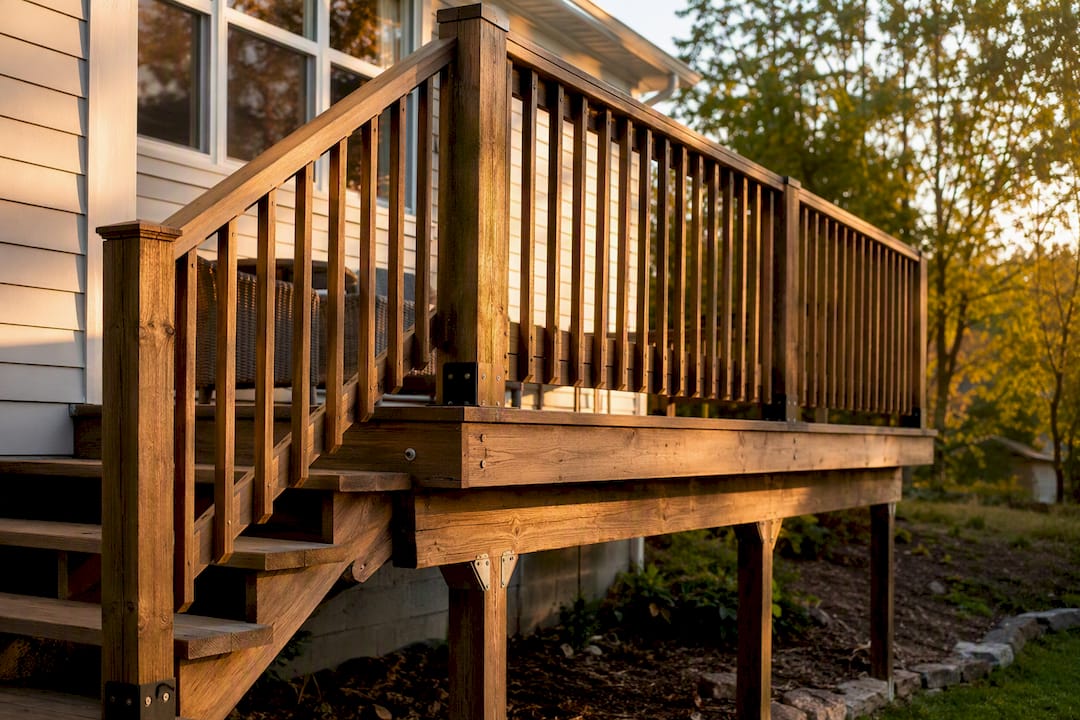
An insurer that finds unpermitted structural work has grounds to deny or reduce a claim tied to that structure, since the coverage was underwritten without knowing the deck existed in its current form. Some policies also require homeowners to disclose major additions, and an unpermitted deck technically falls into that gap even if nobody asked about it directly.
This matters at resale in a specific way: buyers who understand insurance often ask directly whether a deck is permitted, precisely because they know they’ll need to disclose it to their own carrier once they own the place. A “no” answer, or worse, “I’m not sure,” makes them more cautious about the whole transaction, not just the deck.
It’s worth checking your own policy now, before you list, rather than finding out during a claim. If the deck isn’t permitted, ask your carrier directly how it affects coverage on that structure. That answer becomes useful information either way: something to disclose accurately to buyers, or a reason to move faster on getting the deck legalized before you put the house on the market.
Will a Deck Permit Raise Your Property Tax Assessment?
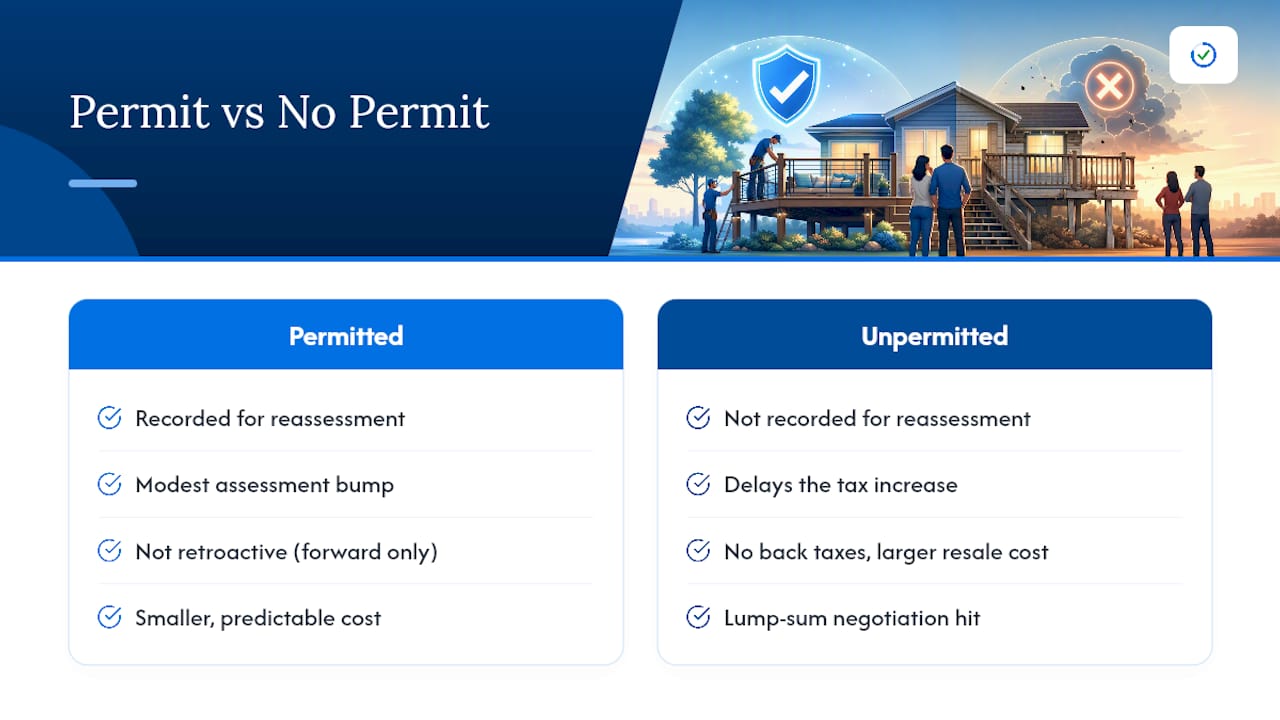
Permitted improvements generally get added to your property’s assessed value, since the permit itself becomes a record the county appraiser’s office can use during reassessment. A finished deck that’s properly permitted typically bumps your assessment up modestly, reflecting the added value it brings to the home.
This is one of the more common reasons homeowners skip the permit process in the first place. Skipping it might delay a tax increase, but it doesn’t eliminate the underlying trade-off. It just shifts the cost from an annual property tax adjustment to a lump-sum negotiation hit at resale, and the resale hit is usually larger.
Sellers sometimes ask whether pulling a retroactive permit right before listing will spike their tax bill unfairly. In most cases, the increase is proportional to the actual improvement and isn’t retroactive itself. You’re not paying years of back taxes. You’re adjusting the assessment going forward, and often the timing works out so the new assessment doesn’t even take effect until after the sale closes, depending on your local assessment calendar.
Think of the tax bump as a small, predictable cost against a much larger and less predictable one: the buyer discount, financing delay, or insurance complication that comes from selling a deck nobody can verify. One is a line item. The other is a negotiation you don’t fully control.
Why It Pays to Resolve Permit Gaps Before You List
Clearing a permit gap almost always beats handing a buyer a credit at closing. A readiness check like MiamiPermitAI catches the missing ledger detail or zoning conflict before you submit, not after a buyer’s inspector finds it. If you’re in a genuine hurry, listing with honest disclosure is a valid fallback. But sellers with even 60 days usually come out ahead by fixing it first.
How MiamiPermitAI Helps You Close Permit Gaps Before You List
MiamiPermitAI is the difference between guessing whether your deck will pass and knowing before you submit anything to the county. Instead of hiring someone to hunt for problems after a buyer’s inspector already has, you review your permit package against Miami 21 zoning, FEMA flood zone requirements, and Florida DBPR contractor licensing before it ever leaves your hands.

You get a readiness score, a prioritized list of what needs fixing, and plain-language guidance instead of code jargon you have to translate yourself. Once you submit, MiamiPermitAI tracks the permit through approval using public Miami-Dade records and emails you status updates, so you’re not the one refreshing a county website every few days. For sellers trying to close a permit gap on a real timeline, that combination of upfront review and post-submission tracking often means the difference between a smooth closing and a stalled one. Start with a permit readiness check before your listing photos even go live.
Sources
- Do you need a permit for a deck? — ISE Engineers
- What happens if I build a deck without a permit? — LegalClarity
Recommended
Is your permit package ready?
Run an AI readiness check against Miami-Dade requirements before you submit.
Start your first projectThis article is general guidance and not legal, engineering, or official county advice. Always verify requirements with Miami-Dade County before submitting a permit.